Can Piles Cause Back Pain? Everything You're Wondering About Piles Symptoms — Answered
If you have been experiencing lower back pain alongside rectal bleeding, discomfort after bowel movements, or an uncomfortable pressure in the anal area — you are probably wondering whether these symptoms are connected. Can piles cause back pain? is one of the most searched health questions in India right now, and it rarely gets a direct, useful answer.
This article gives you that answer — along with the other symptom questions most patients search before finally seeing a doctor.
Can Piles Cause Back Pain? The Direct Answer
The short answer: piles do not directly cause back pain.
Haemorrhoids are swollen blood vessels in and around the anal canal. They do not compress nerves in the spine or lower back, and they do not affect the muscles or discs that generate true lower back pain.
However — there is an important nuance.
Many patients with piles experience discomfort that radiates or feels like it extends into the lower back, tailbone, and pelvic area. This happens for two reasons:
- Referred pain from the pelvic region. The anorectal area and lower back share overlapping nerve pathways in the pelvic floor. Significant inflammation, a large prolapsed haemorrhoid, or a thrombosed external haemorrhoid can generate discomfort that is felt not just at the anus but as a deep, diffuse ache in the lower back or tailbone (coccyx) region. This is not “back pain” in the spinal sense — it is referred pelvic discomfort.
- Postural changes from avoiding pain. Patients with painful piles often unconsciously shift how they sit, stand, and move to reduce anorectal pressure. Over days and weeks, this postural compensation causes genuine secondary back muscle tension and pain — which feels like it comes from the back but is actually a consequence of avoiding piles-related discomfort.
The more important question: If you have lower back pain and rectal bleeding or anorectal discomfort together, both symptoms need assessment. The back pain may be entirely unrelated — or it may be a sign that a pelvic or rectal condition other than haemorrhoids is present. Rectal bleeding with back pain that is worsening, or rectal bleeding with unexplained weight loss, should be evaluated promptly.
At Goyal Piles Care Centre in Rohini, we regularly see patients who have attributed lower back pain to piles — and vice versa. An examination takes under 10 minutes and clarifies the picture completely.
Can Piles Cause Stomach Pain?
Again — not directly, but there is a connection worth understanding.
Haemorrhoids themselves do not cause stomach or abdominal pain. But the conditions that cause piles — primarily chronic constipation, straining, and irregular bowel function — very commonly cause abdominal discomfort, bloating, cramping, and a sensation of incomplete emptying.
Patients who have both piles and chronic constipation often experience:
- Bloating and abdominal distension from retained stool
- Cramping before and during bowel movements
- A persistent sense of heaviness or pressure in the lower abdomen
Treating the piles addresses the haemorrhoidal symptoms. Treating the constipation through dietary change and hydration addresses the abdominal symptoms. Both need attention — fixing one without the other produces incomplete relief.
When stomach pain is a warning sign: If you experience significant abdominal pain together with rectal bleeding — particularly if the blood is dark rather than bright red, or mixed with stool rather than on the surface — this is not a piles pattern. It requires medical evaluation beyond what haemorrhoid treatment addresses.
Can Piles Cause Leg Pain?
No — piles do not cause leg pain through any direct mechanism.
However, a condition that sometimes gets confused with piles — or occurs alongside them in the same patient population — is pelvic vein congestion, which can cause deep leg aching, particularly in women. This is a separate vascular condition requiring specialist evaluation.
Additionally, patients who sit for extended periods (which both worsens piles and is a common work pattern in Delhi's office population) frequently develop sciatica or piriformis-related discomfort that causes leg pain. This is coincidence, not causation — the sitting habit creates both problems independently.
If you have piles symptoms and leg pain, the leg pain should be assessed separately. It is almost certainly not caused by the haemorrhoids.
Can Piles Cause Fever?
An uncomplicated haemorrhoid — even a large, prolapsed one — does not cause fever. Haemorrhoids are non-infectious swellings of blood vessels, not infected tissue.
Fever with anorectal symptoms is a red flag. If you have fever alongside swelling, significant pain, and redness near the anus — this is an abscess until proven otherwise. An anal abscess is a collection of pus from an infected anal gland. It is not a haemorrhoid and requires prompt drainage.
If you have fever with rectal symptoms, do not wait and self-treat. This needs urgent assessment — at Goyal Piles Care Centre or at an emergency facility if the pain is severe.
What Symptoms Do Piles Actually Cause?
Since piles is one of the most over-diagnosed and under-diagnosed conditions simultaneously — patients attribute symptoms to it that it doesn't cause, and miss symptoms it does cause — here is the accurate picture.
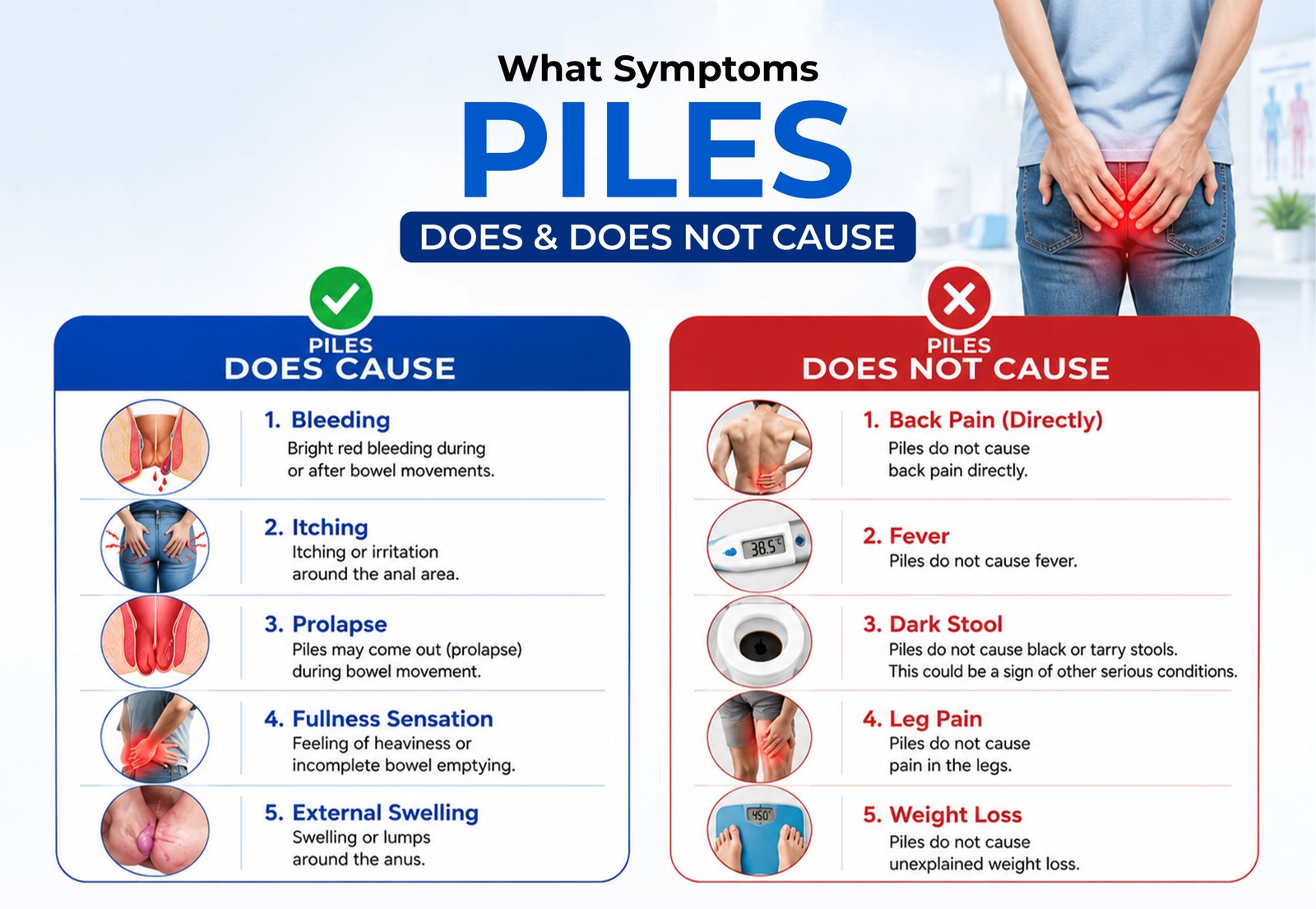
Symptoms Piles DOES Cause
Bleeding — bright red blood during or after a bowel movement. On tissue paper, in the toilet bowl, or coating the stool surface. This is the most common and most reliable piles symptom. The blood is bright red because it comes from vessels close to the surface.
Itching and irritation — particularly around the anal opening. External haemorrhoids and prolapsed internal haemorrhoids cause moisture and mucus discharge that irritates the sensitive perianal skin.
A sensation of fullness or incomplete emptying — large internal haemorrhoids can create a persistent feeling that a bowel movement is not complete, even after the bowel has emptied.
Prolapse — a soft, moist lump that appears at or outside the anal opening during or after bowel movement. Grade II prolapse reduces on its own; Grade III requires manual reduction; Grade IV is permanently prolapsed.
Pain — predominantly from external haemorrhoids and from thrombosed haemorrhoids (where a blood clot forms inside). Internal haemorrhoids above the dentate line are typically painless. Sharp, burning post-defecation pain lasting 1–3 hours is more characteristic of a fissure than of piles.
Swelling — particularly with external haemorrhoids. A visible, tender lump at the anal margin.
Symptoms Piles Does NOT Cause
- Lower back pain (directly)
- Stomach or abdominal pain (directly)
- Leg pain
- Fever (unless there is a secondary infection or abscess)
- Dark or tarry stool
- Significant weight loss
- Change in bowel habits (constipation or diarrhoea lasting weeks)
- Pain deep inside the abdomen
If you have any of the last group of symptoms alongside rectal bleeding — the diagnosis is not piles until proven otherwise. These symptoms need investigation.
Piles Symptoms in Men vs Women — Is There a Difference?
The haemorrhoids themselves are identical in men and women — the same vascular swelling, same grades, same symptoms. What differs is the trigger profile and the likelihood of seeking help.
Women have additional biological triggers: pregnancy (uterine pressure on pelvic veins + elevated progesterone), childbirth straining, and post-menopausal vein changes. Pregnancy-related piles are extremely common and frequently improve conservatively after delivery. Women in India are also statistically less likely to seek assessment early — often attributing symptoms to gynaecological causes or tolerating them out of embarrassment.
Men in the 35–60 age group, particularly those with desk jobs, are the highest-volume piles presentation in our clinic. Long sitting hours, low-fibre diets, and delayed help-seeking are the dominant pattern. The most commonly affected age group for haemorrhoids is the middle age group of 41 to 60 years, with men and women affected roughly equally across the population.
In both cases, the decision to seek help later rather than sooner almost always means a higher grade at presentation — which means fewer non-surgical options available.
How Do I Know If It's Piles — or Something Else?
This is the most important question of all — and the one most patients spend the longest trying to answer from online searches.
The honest answer: you cannot reliably self-diagnose piles, and self-diagnosis is not advisable.
Here is why. Rectal bleeding has multiple causes. Haemorrhoids are among the most common — but conditions including anal fissure, fistula, rectal polyps, inflammatory bowel disease, and in some cases colorectal malignancy can present with similar symptoms. Age increases the importance of proper investigation: a 25-year-old with bright red painless bleeding is almost certainly dealing with haemorrhoids; a 55-year-old with the same symptom needs a proper examination to confirm that.
A clinical examination takes under 10 minutes. It clarifies:
- Whether haemorrhoids are present, and what grade
- Whether a fissure or fistula is the actual cause of symptoms
- Whether any further investigation is needed
The symptoms that most reliably suggest piles are the combination of: bright red blood (not dark), after or during bowel movement (not independent of it), with no significant abdominal pain, and with a history of constipation or straining. But even this combination is not a diagnosis — it is a clinical indication to get examined.
For more on distinguishing between conditions, read our guide on the difference between piles, fissure and fistula.
When to See a Doctor in Rohini — Without Delay
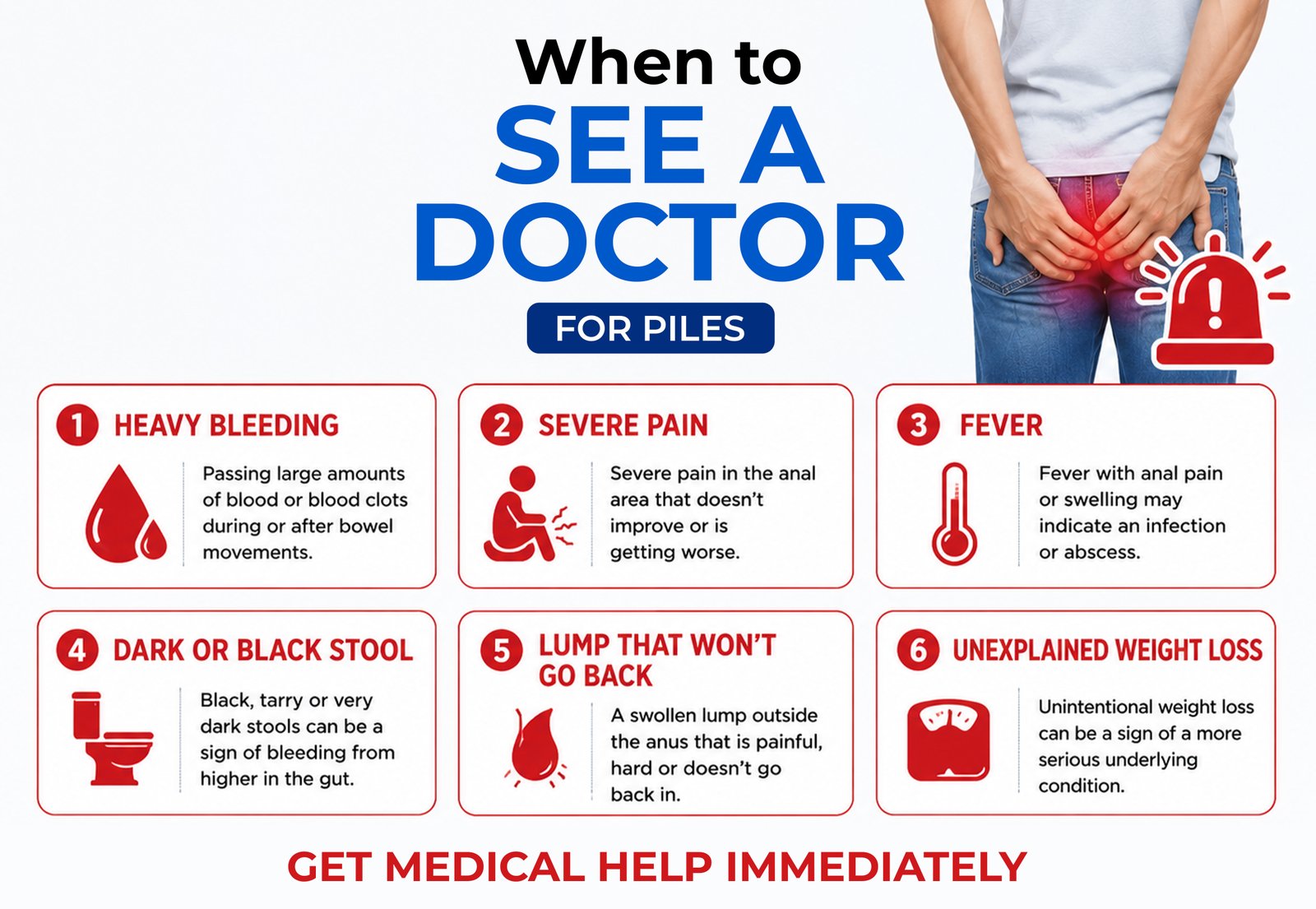
See Dr. Sushil Goyal this week if:
- You have rectal bleeding that has persisted for more than 2 weeks
- You have bleeding with back pain, abdominal pain, or weight loss
- You have fever with anorectal swelling or pain
- You have a painful lump near the anus that appeared suddenly
- You cannot sit comfortably due to anorectal pain
- Self-treatment with cream has not improved symptoms in 2 weeks
- You have had the symptom for months and have been avoiding getting it checked
The most common thing patients say after their first consultation is that they wish they had come sooner.
Goyal Piles Care Centre, Rohini — 37 Years of Accurate Diagnosis
At Goyal Piles Care Centre, every patient receives a proper clinical examination before any treatment is recommended. The examination confirms whether haemorrhoids are present, what grade, whether another condition is the primary diagnosis, and what the appropriate treatment is — all in one visit.
According to the Association of Colon & Rectal Surgeons of India, about 5% of the population has active haemorrhoidal disease at any time. With Delhi's population, that is millions of people — many of whom are searching for answers online rather than getting the 10-minute examination that would tell them everything.
476 verified Google reviews at 4.7 stars. Global Excellence Award 2019 — Best Laser Centre in North India.
📍 D-12/182, First Floor, Sector 8, Rohini, Delhi – 110085
Near Rohini East Metro Station Gate 2 | Opposite Metro Pillar No. 393
📞 Call or WhatsApp: +91-9999333166
Monday to Saturday | 9:30 AM to 1:30 PM
→ Piles treatment options in Rohini
→ Difference between piles, fissure and fistula
→ Piles treatment without surgery
→ Diet after piles treatment
Frequently Asked Questions
Q: Can piles cause lower back pain and pressure? Piles do not directly cause lower back pain. However, significant pelvic inflammation from large or thrombosed haemorrhoids can create referred discomfort felt in the tailbone and lower back area. Additionally, postural changes from avoiding sitting pain can create secondary back muscle tension. If back pain and rectal bleeding occur together, both should be assessed — the combination may indicate a condition other than haemorrhoids.
Q: Can piles cause pain in the stomach? Not directly. However, the chronic constipation that causes piles frequently produces abdominal bloating, cramping, and a sensation of heaviness that patients describe as stomach pain. Treating constipation through dietary change alongside haemorrhoid treatment addresses both problems.
Q: Is it possible to have piles without bleeding? Yes. Grade I haemorrhoids may bleed but are sometimes asymptomatic. External haemorrhoids frequently cause pain, itching, and swelling without bleeding. Grade III and IV haemorrhoids can prolapse without significant bleeding. Absence of bleeding does not rule out haemorrhoids.
Q: Can piles cause pain during urination? Haemorrhoids do not directly affect the urinary tract. However, large prolapsed haemorrhoids can create a sense of pressure in the pelvic area that some patients describe as affecting urination. If urinary symptoms are present alongside rectal symptoms, both should be separately evaluated.
Q: What is the first thing I should do if I think I have piles? Book a clinical examination with a proctologist or specialist. Self-diagnosis from symptoms is unreliable for distinguishing between haemorrhoids, fissure, fistula, and other anorectal conditions. A 10-minute examination at Goyal Piles Care Centre in Rohini confirms the diagnosis, grades the condition, and outlines the appropriate treatment — without any commitment to proceed.
This article is for informational purposes only and does not constitute medical advice. Please consult a qualified medical professional for diagnosis and personalised treatment.
Note: If you are having rectal bleeding with persistent back pain, weight loss, or significant abdominal pain, do not assume the problem is just piles. A proper evaluation is essential.
