Piles Treatment in Delhi Without Surgery — What Are Your Real Options in 2026?
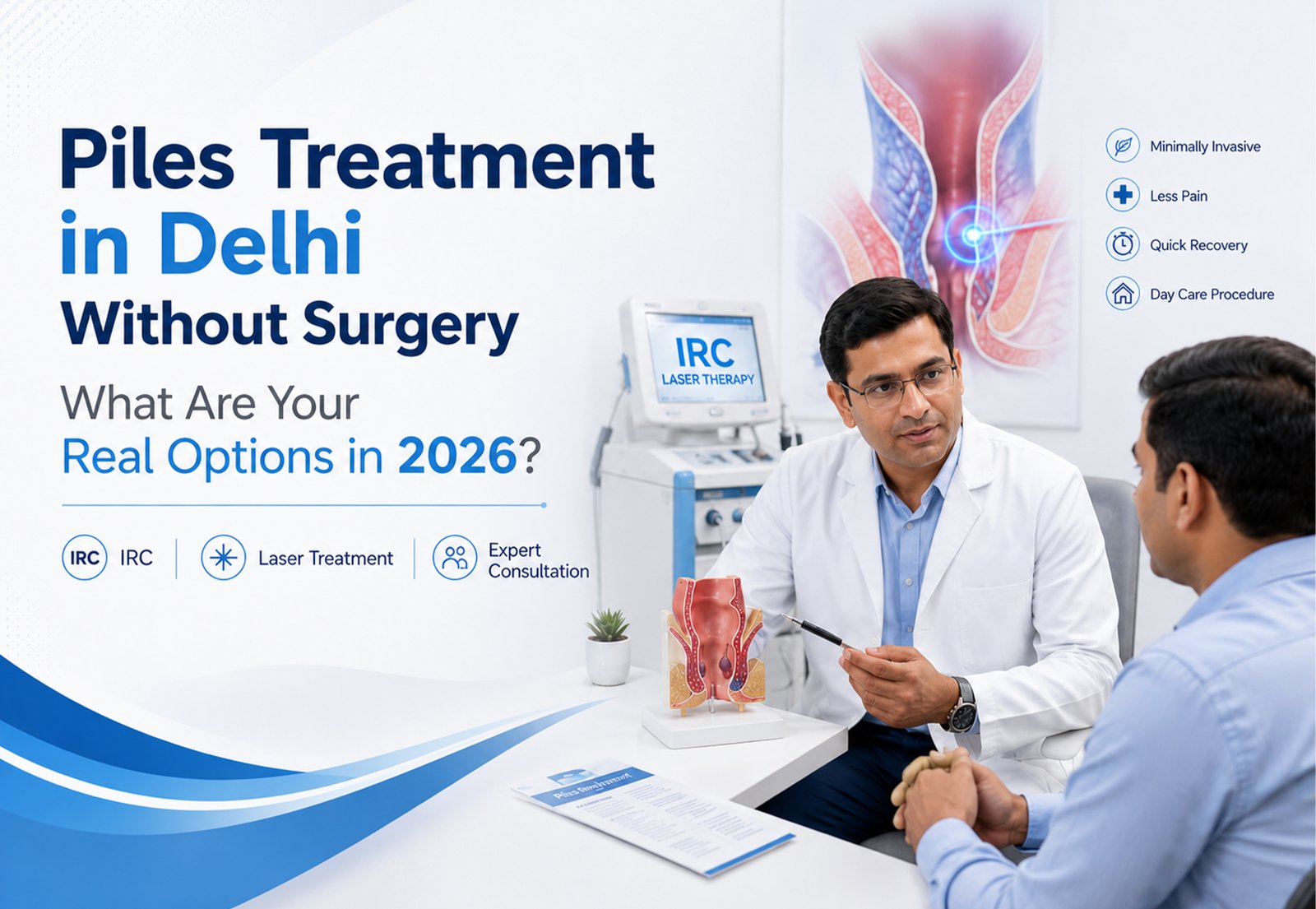
The fear of surgery stops more piles patients from seeking treatment than almost anything else. Patients tolerate bleeding, pain, and discomfort for months — sometimes years — because they assume treatment means going under the knife, taking time off work, and a long and uncomfortable recovery.
The reality in 2026 is significantly different. For the majority of piles patients in Delhi, effective treatment does not require open surgery. What it does require is an accurate grade assessment — because whether you can avoid surgery depends entirely on what grade your haemorrhoids are, which can only be confirmed through a proper clinical examination.
This article covers the full range of non-surgical piles treatment options available in Delhi, which grades qualify for each, what the procedures actually involve, and when — honestly — surgery is the right answer despite a patient's preference to avoid it.
Can Piles Really Be Treated Without Surgery? The Direct Answer
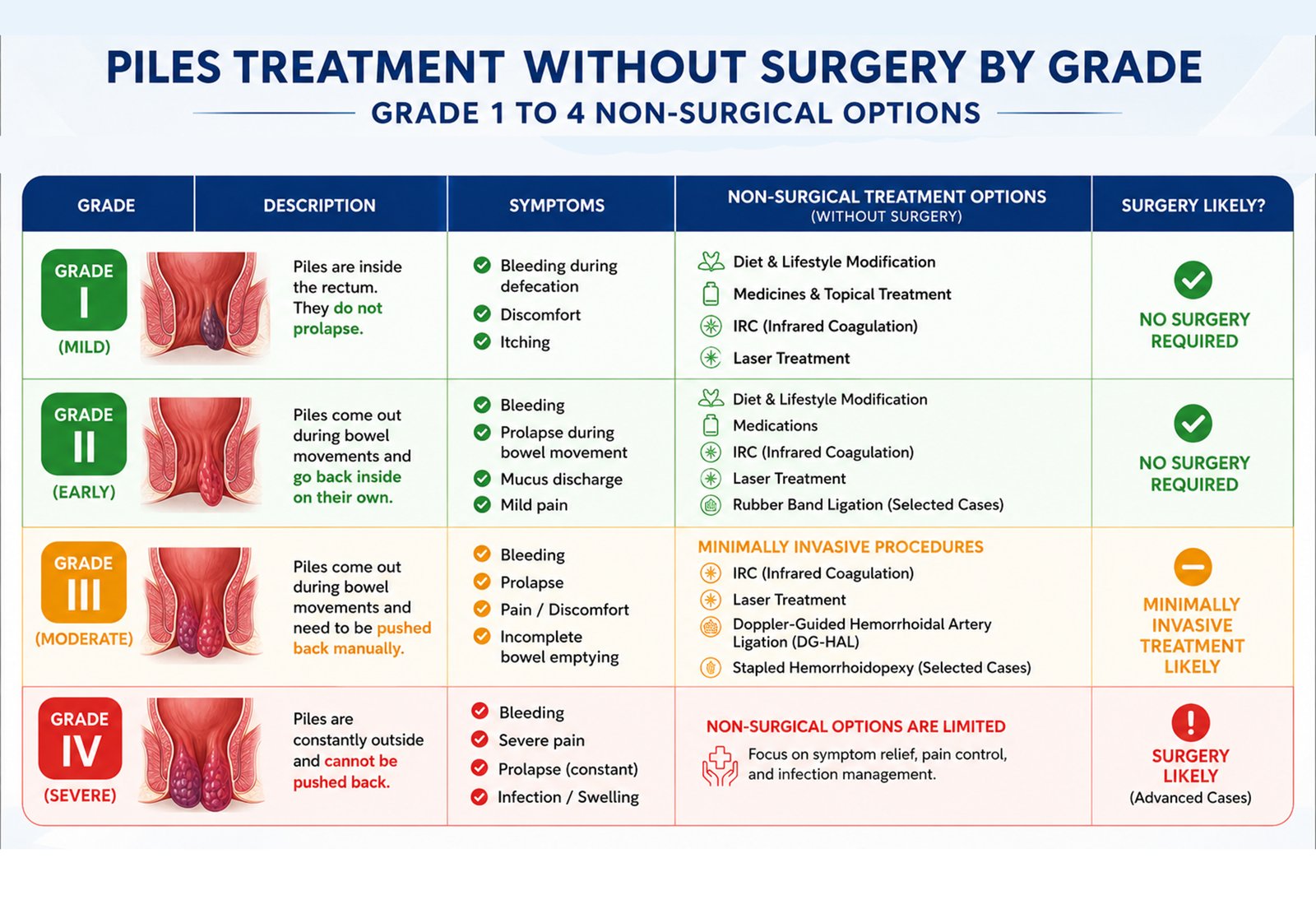
Yes — for most patients. The proportion of piles cases that genuinely require open surgical haemorrhoidectomy is small. The majority of haemorrhoid presentations are Grade I, II, or III — and all three can be effectively managed with non-surgical or minimally invasive procedures.
| Grade | Can It Be Treated Without Open Surgery? | Best Non-Surgical Option |
|---|---|---|
| Grade I | Yes — almost always | Conservative management + IRC |
| Grade II | Yes — in most cases | IRC or Laser (LHP) |
| Grade III | Yes — in many cases | Laser Treatment |
| Grade IV | Requires examination | Examination-based treatment plan |
The important clarification: "without surgery" in piles treatment means treatment without open surgical cutting and stitching. Laser treatment and IRC are minimally invasive options selected after examination.
What Does "Non-Surgical Piles Treatment" Actually Cover?
The term is used loosely — by clinics, by aggregator websites, and by patients — in ways that can be confusing. Here is a clear breakdown of what each category actually means.
1. Conservative Management — Diet, Lifestyle, Medication
Best for: Grade I, early Grade II, and pregnant patients
Conservative management is the starting point for mild haemorrhoids and involves no procedure at all:
- High-fibre diet — 25–35 grams of dietary fibre daily through dals, fruits, vegetables, oats, and dalia (see our diet after piles treatment guide)
- Adequate hydration — 2.5–3 litres of water per day to keep stools soft
- Warm sitz baths — 10–15 minutes in warm water, 2–3 times daily, to reduce inflammation and promote healing
- Topical preparations — doctor-prescribed ointments to reduce pain and swelling
- Stool softeners — prescribed where constipation is the dominant driver
For Grade I piles and early Grade II, consistent conservative management resolves symptoms in many patients within 4–6 weeks. If symptoms persist beyond this period or recur repeatedly, a procedural option becomes appropriate.
2. IRC — Infrared Coagulation
Best for: Grade I and Grade II internal haemorrhoids
IRC is the most commonly performed non-surgical piles procedure at Goyal Piles Care Centre in Rohini. A brief pulse of infrared light is directed at the base of each haemorrhoid, creating a small controlled scar that blocks its blood supply. The haemorrhoid shrinks and detaches naturally over 7–14 days.
Why patients in Delhi choose IRC:
- No anaesthesia — the probe contacts tissue above the pain-sensitive zone
- No hospital admission — the procedure takes 5–10 minutes in the clinic
- Same-day return — patients drive themselves home and return to work the same day
- No preparation required — no fasting, no bowel prep
Cost at Goyal Piles Care Centre, Rohini:
- Complete IRC treatment: ₹30,000–₹35,000
Each sitting treats one or two haemorrhoids. Treating all columns across 3 sittings rather than one session produces better patient comfort and equivalent outcomes.
"I was suffering from piles for 4 years. Now I'm perfectly fine. It was totally painless treatment. I didn't know that piles treatment without surgery was also possible." — Verified Google Review, Goyal Piles Care Centre
Read our complete IRC treatment guide for Rohini patients for a full session-by-session breakdown.
3. Laser Haemorrhoidoplasty (LHP) — Day Care Laser
Best for: Grade II and Grade III internal haemorrhoids
Laser Haemorrhoidoplasty uses a precisely calibrated laser fibre inserted into the haemorrhoidal tissue. The laser energy causes the haemorrhoidal mass to shrink from within — without any cutting, open wound, or stitches. The procedure is performed under local or spinal anaesthesia on a day-care basis.
Why patients in Delhi choose laser:
- No open wound — no cutting, no stitches, no surgical scar
- Day care — no overnight admission required
- Fast recovery — return to desk work in 1–2 days, physical work in 5–7 days
- Single session — all haemorrhoids treated in one visit
Cost at Goyal Piles Care Centre, Rohini: ₹50,000–₹60,000 all-inclusive (procedure fee, day-care facility, anaesthesia)
Insurance coverage depends on your policy. For a complete breakdown of treatment costs, see our laser piles treatment cost guide for Delhi 2026.
4. Advanced Laser Treatment for Piles
Best for: Grade III and Grade IV haemorrhoids
Advanced laser treatment is a minimally invasive day-care option for suitable prolapsed piles. The exact treatment plan is confirmed after examination.
- No open wound in the anal canal
- No stitches in the sensitive perianal area
- Performed under spinal anaesthesia
- One night of admission typically required
- Return to work in 5–7 days vs 2–3 weeks for open surgery

Cost at Goyal Piles Care Centre, Rohini: ₹50,000–₹60,000 all-inclusive.
Complete Cost Comparison — Non-Surgical Piles Treatment in Rohini, Delhi (2026)
| Treatment | Grade | Cost at Goyal Piles Care Centre | Sessions | Anaesthesia | Return to Work |
|---|---|---|---|---|---|
| Conservative management | I | Consultation + prescription only | Ongoing | None | Immediate |
| IRC | I–II | ₹30,000–₹35,000 all-inclusive | Complete treatment | None | Same day |
| Laser (LHP) | II–III | ₹50,000–₹60,000 (all-inclusive) | 1 | Local/Spinal | 1–2 days |
Which Treatment Is Right for Your Grade?
If your main symptom is painless bleeding with no prolapse (likely Grade I): → Start with conservative management. If that fails after 4–6 weeks, IRC at ₹30,000–₹35,000 all-inclusive may be appropriate after examination.
If you have a lump that comes out but returns on its own (likely Grade II): → IRC (~₹30,000 total) or Laser (₹50,000–₹60,000). The choice depends on size and number of columns — confirmed at examination.
If the lump comes out and you have to push it back manually (likely Grade III): → Laser Treatment at ₹50,000–₹60,000 may be appropriate after examination.
If the lump is permanently out and cannot be reduced (likely Grade IV): → An examination is required to determine the appropriate treatment plan.
Will Piles Come Back After Non-Surgical Treatment?
Non-surgical treatment addresses the existing haemorrhoids. It does not remove the conditions that caused them. If constipation, low-fibre diet, straining, and inadequate hydration continue after treatment, haemorrhoids can recur — regardless of whether the original treatment was IRC, laser, or open surgery.
The most reliable predictor of long-term success is permanent dietary and lifestyle change: daily fibre, adequate hydration, no straining, and an active lifestyle. Our diet after piles treatment guide covers the specific changes that protect against recurrence.
Why the Grade-Wise Approach Matters — A Note From Our Clinic
At Goyal Piles Care Centre in Rohini, one pattern repeats itself across 37 years of practice: patients who come early — when symptoms are Grade I or II — have far more non-surgical options, shorter treatment courses, faster recovery, and significantly lower total cost.
Piles Treatment Without Surgery in Rohini, Delhi
Goyal Piles Care Centre at D-12/182, First Floor, Sector 8, Rohini has offered non-surgical piles treatment as its primary approach for 37 years. The clinic has 476 verified Google reviews at 4.7 stars and received the Global Excellence Award 2019 — Best Laser Centre in North India.
📍 D-12/182, First Floor, Sector 8, Rohini, Delhi – 110085
Near Rohini East Metro Station Gate 2 | Opposite Metro Pillar No. 393
📞 Call or WhatsApp: +91-9999333166
Monday to Saturday | 9:30 AM to 1:30 PM
Frequently Asked Questions
Q: Can piles of Grade III be treated without open surgery in Delhi?
Grade III haemorrhoids can frequently be treated with Laser Treatment at ₹50,000–₹60,000 all-inclusive. The appropriate plan depends on size and degree of prolapse — confirmed at examination by Dr. Sushil Goyal.
Q: Is laser piles treatment considered "without surgery"?
Yes. Laser Haemorrhoidoplasty involves no scalpel, no open incision, and no stitches. It is a minimally invasive day-care procedure.
Q: What is the cost of IRC piles treatment in Delhi?
IRC treatment at Goyal Piles Care Centre costs ₹30,000–₹35,000 all-inclusive.
Q: Is non-surgical piles treatment covered by insurance in Delhi?
Insurance coverage depends on your policy. Confirm the coverage and required documents with your TPA before booking.
This article is for informational purposes only and does not constitute medical advice. Please consult a qualified medical professional for diagnosis and personalised treatment recommendations.
