Top 5 Questions Patients in Rohini Ask About Piles — Answered by Dr. Sushil Goyal
In 37 years of treating piles at Goyal Piles Care Centre in Rohini, certain questions come up consistently — from first-time patients, from patients who have had piles for years, and from family members accompanying patients to consultations.
This article answers the five most frequently asked questions about piles at our clinic, with the same clinical honesty we give every patient who walks through our door.
Question 1: What Is the Relationship Between Iron Supplements and Piles?
This question comes from two directions: patients who bleed from piles and wonder if they need iron supplements, and patients on iron supplements who find their constipation and piles have both worsened.
The bleeding-iron connection:
Haemorrhoids are swollen blood vessels in or around the anus and rectum. When they bleed — as internal haemorrhoids commonly do during bowel movements — blood is lost. In patients with Grade II or higher piles who experience frequent or heavy bleeding, this blood loss over weeks or months can contribute to iron deficiency anaemia. Symptoms include fatigue, weakness, pallor, and shortness of breath.
However, anaemia from piles is not inevitable. Grade I piles that bleed lightly and intermittently rarely cause significant iron loss. Patients with symptomatic anaemia should have their haemoglobin checked and, if iron deficiency is confirmed, iron supplementation may be appropriate — but always in consultation with a doctor.
The iron-constipation-piles cycle:
Here is what many patients do not know: iron supplements cause constipation as a very common side effect. Elemental iron, particularly in higher doses, slows bowel transit and produces dark, harder stools. For a patient already dealing with piles — where constipation and straining are the primary aggravating factors — this creates a frustrating cycle:
Piles bleed → anaemia → iron supplement prescribed → constipation worsens → straining increases → piles bleed more
What to do:
If you are on iron supplements and have piles, discuss the dose and formulation with your doctor. Liquid iron preparations and lower-dose supplementation are often better tolerated. Increase dietary fibre and fluid intake significantly when taking iron to counteract the constipating effect. Ferrous bisglycinate and iron polymaltose formulations cause less GI upset than ferrous sulphate in many patients.
Treat the piles appropriately so the bleeding is resolved — this reduces the need for iron supplementation in the first place.
Question 2: What Is Haemorrhoidectomy — and Do I Need One?
The word "haemorrhoidectomy" is one of the most anxiety-producing terms patients encounter when researching piles, because it sounds like major surgery. Here is what it actually means — and when it is, and is not, required.
What haemorrhoidectomy is:
Haemorrhoidectomy is the surgical removal of haemorrhoidal tissue. The surgeon cuts away the enlarged blood vessel clusters and the surrounding tissue, leaving the area to heal. It is performed under spinal or general anaesthesia and typically requires one to two nights of hospital admission.
When it is the right treatment:
Haemorrhoidectomy is generally reserved for Grade IV haemorrhoids — where the prolapsed tissue is permanently outside the anal canal and cannot be reduced — and for complex or recurrent Grade III cases where less invasive options have not produced lasting relief.
Grade IV haemorrhoids are permanently prolapsed and require treatment or surgery.
When it is NOT needed:
The majority of patients who present to Goyal Piles Care Centre do not need open surgery. Grade I haemorrhoids are managed with IRC or conservative treatment. Grade II and suitable Grade III haemorrhoids may be treated with laser treatment after examination.
The fear of "being cut" is one of the primary reasons patients delay seeking treatment for years. In doing so, Grade I becomes Grade II, Grade II becomes Grade III, and the situation that eventually requires surgery is created by the delay — not by the condition itself.
At Goyal Piles Care Centre: Haemorrhoidectomy is recommended only when it is genuinely the appropriate option for a specific patient's grade and anatomy. Treatment is never upgraded to a more invasive procedure for convenience or cost reasons.
Question 3: What Are the Non-Surgical Treatment Options for Piles in Rohini?
This is asked by almost every patient who is not yet at a grade requiring surgery. The answer in 2026 is considerably better than it was even a decade ago — non-surgical options now cover Grades I, II, and many Grade III presentations effectively.
Option 1 — Conservative Management (Grade I, early Grade II)
No procedure at all. High-fibre diet (25–35 grams daily), 2.5–3 litres of water, warm sitz baths 2–3 times daily, and prescribed topical preparations. For a genuine Grade I haemorrhoid in a patient who has not had prolonged symptoms, this resolves the condition in many cases within 6–8 weeks — permanently, if dietary changes are maintained.
Option 2 — IRC: Infrared Coagulation (Grade I–II)
The most commonly performed non-surgical procedure at Goyal Piles Care Centre. IRC uses infrared light to create a controlled scar at the base of the haemorrhoid, cutting off its blood supply. The haemorrhoid shrinks and detaches naturally over 7–14 days.
- No anaesthesia
- No hospital admission
- 5–10 minutes in the clinic
- Same-day return to work
- Cost at Goyal Piles Care Centre, Rohini: ₹30,000–₹35,000 all-inclusive
Option 3 — Laser Haemorrhoidoplasty (Grade II–III)
A laser probe is inserted into the haemorrhoidal tissue under local or spinal anaesthesia. The laser shrinks the haemorrhoid from within — no cutting, no stitches, no open wound.
- Day care procedure
- Return to desk work in 1–2 days
- Cost at Goyal Piles Care Centre, Rohini: ₹50,000–₹60,000 all-inclusive (procedure + day care facility + anaesthesia)
Option 4 — Advanced Laser Treatment (Grade III–IV)
Laser treatment is a minimally invasive option for suitable advanced piles. The treatment plan is confirmed after examination.
- One night admission
- Return to work in 5–7 days vs 2–3 weeks for open haemorrhoidectomy
- Cost at Goyal Piles Care Centre, Rohini: ₹50,000–₹60,000 all-inclusive
The right non-surgical or minimally invasive option is always the one matched to your grade after examination — not the cheapest or the most convenient.
Question 4: How Can I Safely Treat Piles During Pregnancy?
Pregnancy is one of the most common triggers for haemorrhoids — and one of the most anxiety-producing situations for treatment decisions, because patients are rightly concerned about what is safe for their baby.
Why pregnancy causes piles:
Two mechanisms work together. As the uterus grows, it compresses the pelvic veins, restricting blood return from the lower body and causing the rectal vessels to engorge. Simultaneously, elevated progesterone relaxes blood vessel walls, making them more susceptible to swelling. Constipation — extremely common during pregnancy due to hormonal changes, reduced activity, and iron supplementation — adds straining to the mix.
What is safe during pregnancy:
The internationally recommended approach during pregnancy is conservative management first. This means:
- High-fibre diet — dalia, oats, moong dal, fruits, vegetables — softens stools and reduces straining
- 2.5–3 litres of water daily — essential for stool softness, especially if taking iron supplements
- Warm sitz baths — 10–15 minutes, 2–3 times daily — reduces swelling and discomfort safely
- Topical preparations — only those specifically approved for use in pregnancy by your obstetrician
- Daily gentle walking — 20–30 minutes maintains bowel motility and reduces constipation risk
- Not delaying toilet visits — responding to urges promptly rather than ignoring them
What to avoid during pregnancy:
Do not self-medicate with over-the-counter piles creams without confirming safety with your obstetrician. Many topical preparations contain vasoconstrictors or local anaesthetics that require assessment for pregnancy compatibility.
Procedures during pregnancy:
IRC, laser, and surgical procedures are generally deferred until after delivery unless bleeding is severe enough to cause significant anaemia. Haemorrhoids during pregnancy often improve significantly after delivery with conservative management. Most pregnancy-related haemorrhoids that remain symptomatic beyond 6–8 weeks post-delivery are then assessed for IRC or other appropriate treatment.
When to see Dr. Sushil Goyal during pregnancy:
If bleeding is heavy, if pain is severe and affecting sleep or daily activity, or if a lump is acutely thrombosed — do not wait. An assessment will confirm whether the symptom is a haemorrhoid or something requiring different management.
Question 5: How Is Piles Diagnosed — What Will the Doctor Actually Do?
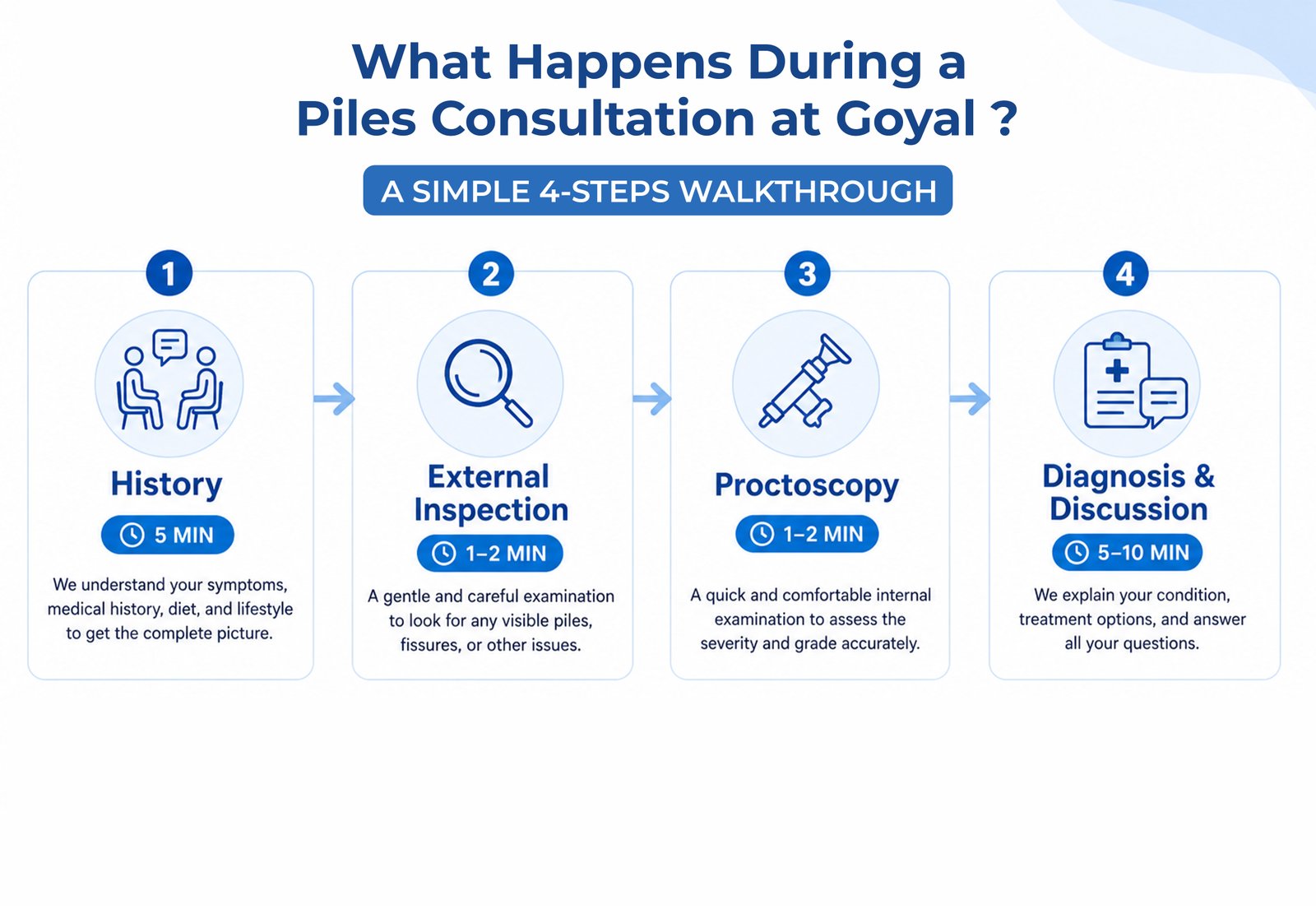
Many patients delay their first appointment because they are not sure what the examination involves. A clear, honest answer removes that barrier.
Step 1 — Clinical History (5 minutes)
Dr. Sushil Goyal begins every consultation with a structured clinical history: how long symptoms have been present, what type of bleeding (bright red, dark, on tissue or in bowl), whether there is prolapse and whether it reduces on its own, pain pattern, bowel habits, diet, and any previous treatment. This history often narrows the probable grade before any physical examination.
Step 2 — External Inspection (1–2 minutes)
You will be asked to lie on your side on the examination table. Dr. Goyal will gently inspect the perianal area for external haemorrhoids, skin tags, fissures, or any visible external pathology. This is visual — no instruments at this stage.
Step 3 — Proctoscopy (1–2 minutes)
A proctoscopy involves inserting a small, lighted plastic tube into the anal canal to directly observe internal haemorrhoids. The instrument is approximately the width of a finger. Most patients experience mild pressure rather than pain — the internal anal canal above the dentate line has very few pain nerve endings. The examination takes under two minutes.
This examination confirms:
- Whether internal haemorrhoids are present
- Their grade (I through IV)
- Whether a fissure, fistula, or other anorectal condition is also present
Step 4 — Diagnosis and Treatment Discussion (5–10 minutes)
After examination, Dr. Sushil Goyal explains your grade, what it means, what treatment options are appropriate for your specific grade and symptoms, the expected outcome of each option, and the complete cost. You are never pressured to commit to a procedure on the day of your first visit.
Digital Rectal Examination (DRE):
A Digital Rectal Exam is frequently performed to search for abnormalities such as internal haemorrhoids, rectal tumours, or other causes of rectal bleeding. In this procedure, a gloved, lubricated finger is inserted to assess the anal canal and lower rectum. This is standard and takes under one minute.
The total consultation — history, inspection, proctoscopy, and discussion — typically takes 20–30 minutes at Goyal Piles Care Centre.
When to Book — A Final Note
If any of these five questions is something you have been wondering about, the next step is a proper examination rather than continued searching. The diagnosis, grade, and treatment discussion that comes from a 20-minute consultation tells you more than hours of research — and it is the only way to get an answer specific to your situation rather than a general one.
Quick Reference: Piles Treatment Costs at Goyal Piles Care Centre, Rohini (2026)
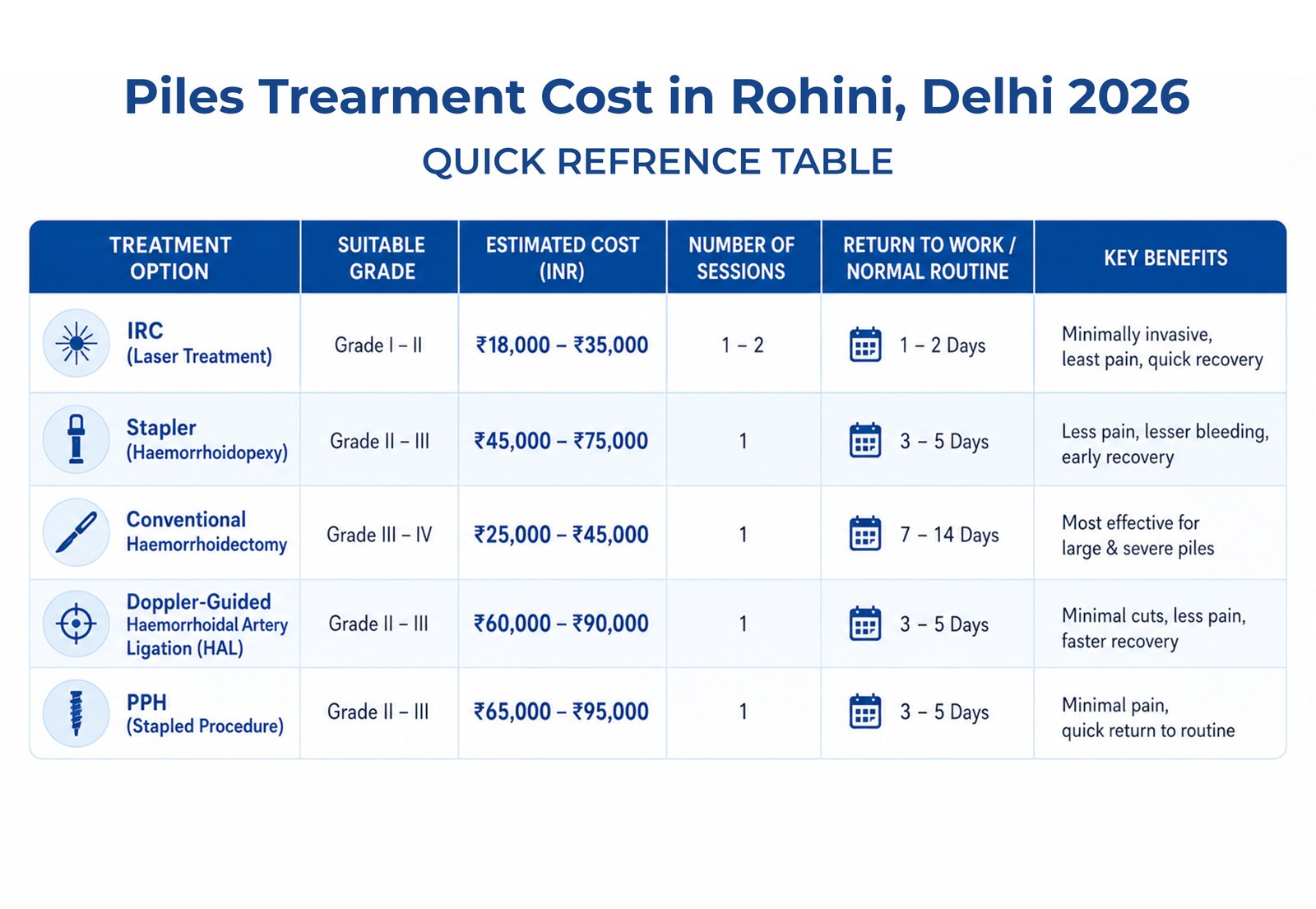
| Treatment | Grade | Cost | Sessions | Return to Work |
|---|---|---|---|---|
| Conservative management | I | Consultation + prescription | Ongoing | Immediate |
| IRC Infrared Coagulation | I–II | ₹30,000–₹35,000 | 3 | Same day |
| Laser Haemorrhoidoplasty | II–III | ₹50,000–₹60,000 (all-inclusive) | 1 | 1–2 days |
| Laser Treatment | III–IV | ₹50,000–₹60,000 (all-inclusive) | 1 | 5–7 days |
| Haemorrhoidectomy | IV | ₹50,000–₹60,000 (all-inclusive) | 1 | 2–3 weeks |
Written by Dr. Sushil Goyal, MBBS, FCGP — Piles and Anorectal Specialist, Goyal Piles Care Centre, Rohini, Delhi. Last reviewed: August 2026.
This article is for general informational purposes only and does not constitute medical advice. Please consult a qualified medical professional for diagnosis and personalised treatment.
