Pilonidal Sinus Treatment in Rohini, Delhi — Laser Surgery Without the Long Recovery
If you have been dealing with a painful swelling, discharge, or recurring infection near the top of your buttocks — and you have been avoiding seeing a doctor because you assume it means a major operation and weeks of recovery — this article is for you.
Every year, more than 1 million cases of pilonidal sinus are diagnosed in India, yet it remains one of the least-discussed anorectal conditions. Many patients — particularly young men with desk jobs — spend months managing it with warm compresses and painkillers before finally seeking proper treatment.
The good news: laser treatment for pilonidal sinus has transformed what was once a condition requiring weeks of wound care into a day-care procedure with a significantly faster recovery. Here is everything you need to know before booking an appointment in Rohini.
What Is Pilonidal Sinus — Explained Simply
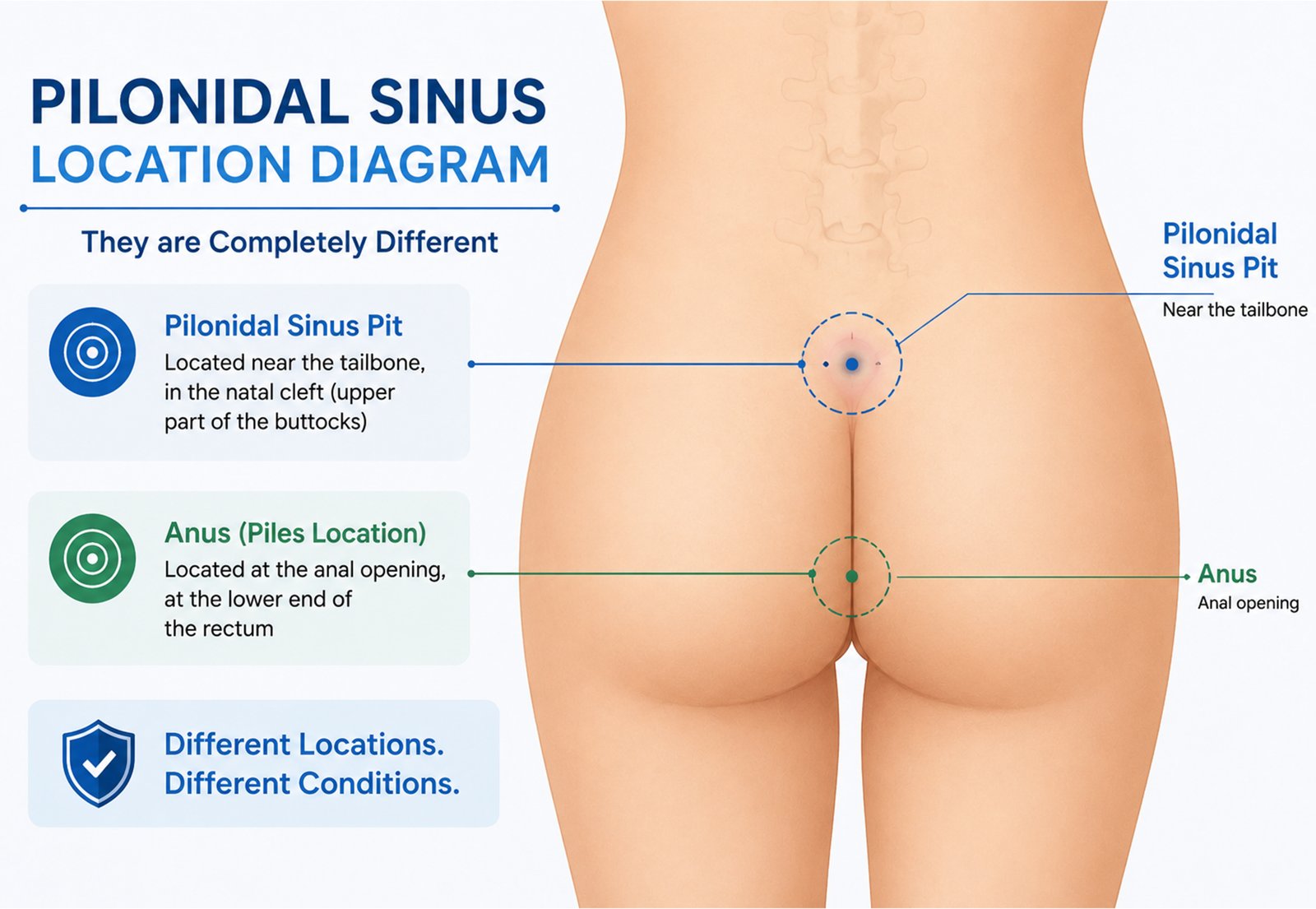
A pilonidal sinus is a small tunnel or channel that forms in the skin near the tailbone — at the very top of the cleft between the buttocks. It typically contains hair, skin debris, and bacteria.
The name comes from Latin: pilus (hair) + nidus (nest). In most cases, the sinus forms when loose or ingrown hairs pierce the skin and burrow inward. The body reacts by forming a channel — the sinus — around the foreign material.
When a pilonidal sinus becomes infected, it forms a pilonidal abscess — a painful, swollen, red collection of pus at the top of the buttock crease. At this stage, the pain can make sitting, walking, and even lying down extremely uncomfortable.
The three stages patients typically experience:
- Asymptomatic — a small pit or dimple near the tailbone with no symptoms. Many patients don't know they have it until it becomes infected.
- Abscess — sudden onset of pain, swelling, redness, and a pus-filled lump. Often accompanied by fever. The most acutely painful stage.
- Chronic sinus — after the abscess drains (spontaneously or surgically), a persistent channel remains that intermittently discharges pus or fluid. The infection cycles between quiet and acute phases.
Who Gets Pilonidal Sinus? — The Typical Patient Profile
Pilonidal sinus is most commonly seen in young adult males between 15 and 35 years old, especially those with thick body hair, a deep natal cleft, a sedentary job that involves prolonged sitting — such as drivers, IT professionals, and desk workers — and those who are overweight.
In our patient population at Goyal Piles Care Centre in Rohini, pilonidal sinus most commonly presents in:
- Men aged 18–40 working in IT, BPO, or office environments in Delhi NCR
- Long-distance drivers and cab/auto drivers in Rohini and surrounding areas
- College students spending extended hours seated at desks
- Men with naturally thick or coarse hair
Women are affected less frequently but do develop pilonidal sinus — particularly those with higher BMI or a deep natal cleft anatomy.
Causes of Pilonidal Sinus
The exact mechanism is well understood even if the original trigger varies by patient:
- Hair penetration — loose or broken hairs in the natal cleft create friction during walking and sitting. This friction can drive hair shafts into the skin, triggering an inflammatory response that forms the sinus tract.
- Friction and pressure — prolonged sitting creates constant pressure and friction in the natal cleft area, pushing hair and debris into the skin and preventing natural hair clearance.
- Hormonal factors — the condition is most common in the 15–35 age group, when sebaceous gland activity is highest and hair is coarsest.
- Anatomy — a deep natal cleft creates a warm, moist, poorly ventilated environment that retains hair and promotes bacterial growth.
- Hygiene difficulty — the location makes thorough cleaning difficult, allowing bacteria to accumulate.
Symptoms — How to Know If You Have Pilonidal Sinus
Classic symptoms:
- Pain, swelling, or redness at the top of the buttock crease (near the tailbone)
- A small pit, dimple, or hole in the skin in this area — sometimes multiple pits
- Pus or bloody fluid draining from the area
- Foul-smelling discharge
- Difficulty sitting comfortably
- Fever or chills during an acute abscess episode
What it is NOT:
- Pilonidal sinus is not a piles (haemorrhoid) condition — it affects the skin near the tailbone, not the anal canal
- It is not sexually transmitted and has no connection to sexual activity
- It does not affect bowel function
Many patients confuse pilonidal sinus with a boil, a cyst, or piles. The location is distinctive — top of the natal cleft near the tailbone, not near the anus itself. If you have any doubt, an examination by Dr. Sushil Goyal confirms the diagnosis within minutes.
Pilonidal Sinus Treatment Options in Rohini, Delhi
1. Incision and Drainage (I&D) — For Acute Abscess
When you arrive with an acutely painful abscess — swollen, red, pus-filled — the first priority is drainage to relieve pressure and treat the infection.
I&D is performed under local anaesthesia as an OPD procedure. The abscess is opened, drained, and cleaned. This provides immediate pain relief. However, I&D treats the abscess — not the underlying sinus tract. Without definitive treatment of the sinus itself, recurrence is common.
Important: I&D is a temporary measure. After the acute episode settles (typically 6–8 weeks), definitive treatment of the sinus is necessary to prevent recurrence.
Cost at Goyal Piles Care Centre, Rohini: ₹3,000–₹8,000 (depends on size and complexity of abscess).
2. Laser Pilonidal Sinus Treatment — Day Care, Fast Recovery
Laser treatment for pilonidal sinus is the procedure of choice for uncomplicated and recurrent sinuses at Goyal Piles Care Centre. It involves inserting a small laser probe directly into the sinus tract. Laser energy destroys the tract from within, sealing it closed without requiring a large external incision.
Why patients in Rohini choose laser:
- No large open wound — compared to conventional wide excision, which leaves a large raw wound requiring weeks of daily dressing
- Day care — patients go home the same day
- Faster return to sitting and work — typically 5–7 days for desk workers vs 4–6 weeks for open surgery
- Minimal dressing required — a small external opening closes quickly
- Lower recurrence risk — when the entire tract is accurately treated
What to expect:
- Spinal or local anaesthesia depending on extent of sinus
- Procedure takes 20–45 minutes
- Discharged same day or after one overnight stay
- Mild discomfort for 3–5 days
- Return to desk work: 5–7 days
- Return to physical work/driving: 2–3 weeks
- Follow-up in 1–2 weeks to confirm healing
Cost at Goyal Piles Care Centre, Rohini: ₹40,000–₹70,000 all-inclusive (procedure + facility + anaesthesia). Most health insurance policies cover pilonidal sinus surgery under surgical benefits. Confirm with your TPA before booking.
3. Conventional Excision Surgery — For Complex or Recurrent Cases
Conventional wide excision removes the entire sinus tract and surrounding tissue. It is the most thorough option for complex, branching, or extensively recurrent sinuses — but requires the longest recovery.
Recovery: 4–6 weeks of wound care. Daily dressing changes. Restricted sitting for 2–3 weeks. Return to desk work in 3–4 weeks, physical work in 5–6 weeks.
When Dr. Sushil Goyal recommends conventional surgery: When the sinus tract is complex, has multiple branches, or has recurred after laser treatment and the anatomy requires open access for complete clearance.
Cost at Goyal Piles Care Centre, Rohini: ₹35,000–₹65,000 all-inclusive.
Laser vs Conventional Surgery — Which Is Right for You?
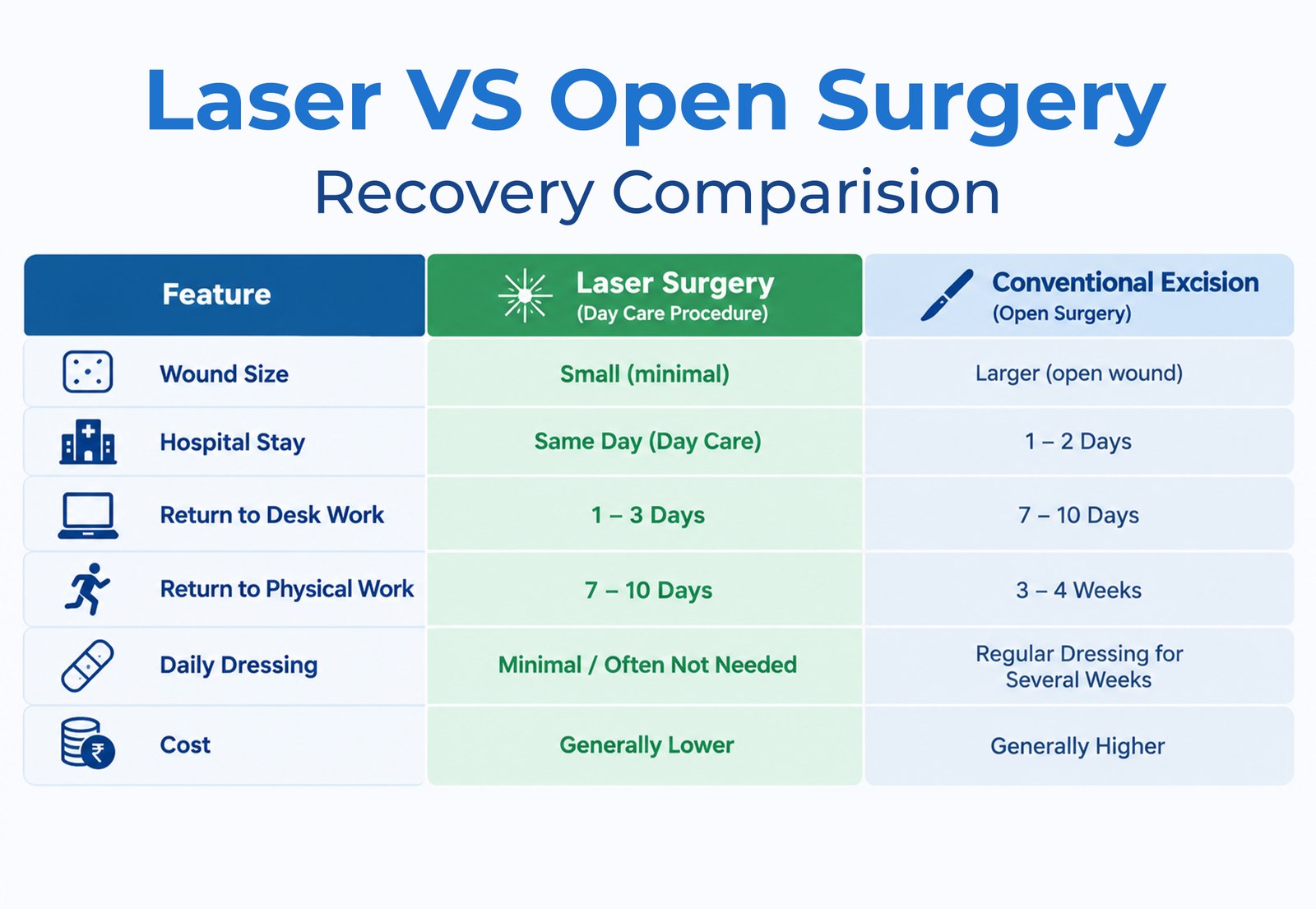
| Feature | Laser Treatment | Conventional Excision |
|---|---|---|
| Wound size | Minimal — small entry point | Open wound requiring daily dressing |
| Anaesthesia | Local or Spinal | Spinal |
| Hospital stay | Day care or 1 night | 1–2 nights |
| Return to desk work | 5–7 days | 3–4 weeks |
| Return to physical work | 2–3 weeks | 5–6 weeks |
| Daily dressing | Minimal | Required for 4–6 weeks |
| Best for | Uncomplicated + recurrent sinuses | Complex, branching, extensive sinuses |
| Cost (Rohini 2026) | ₹40,000–₹70,000 | ₹35,000–₹65,000 |
| Insurance | Usually covered | Usually covered |
For the large majority of patients presenting with an uncomplicated or first-recurrence sinus, laser treatment is the better option — less pain, faster return to work, and comparable cure rates when the full tract is accurately treated.
Will Pilonidal Sinus Come Back After Treatment?
Every year more than 1 million cases of pilonidal sinus surface and patients suffer with the problem of recurrence due to either faulty diagnosis or improper surgery. Recurrence is the most common concern — and it is legitimate.
Recurrence after pilonidal sinus treatment happens for two main reasons:
- Incomplete treatment of the tract — if any part of the sinus including secondary pits or extensions is missed, the residual tract can reactivate.
- Failure to address the underlying cause — hair continues to penetrate the skin after treatment if no preventive measures are taken.
Reducing recurrence risk:
- Laser hair removal from the natal cleft area — the single most effective preventive measure. Removing hair from the area eliminates the primary re-entry mechanism. Many patients choose laser hair removal 6–8 weeks after sinus treatment.
- Regular washing and drying of the natal cleft area
- Weight management — reducing BMI reduces pressure and friction
- Avoiding prolonged sitting — taking a 5-minute standing break every 60–90 minutes
- Regular shaving or trimming of natal cleft hair if laser hair removal is not undertaken
Frequently Asked Questions
Q: Is pilonidal sinus the same as piles?
No — they are completely different conditions. Piles (haemorrhoids) are swollen blood vessels inside or around the anal canal. Pilonidal sinus is a tunnel in the skin near the tailbone, caused by hair penetrating the skin. They affect different anatomical locations and require different treatments. However, both can be treated at Goyal Piles Care Centre in Rohini by Dr. Sushil Goyal.
Q: Can pilonidal sinus heal without surgery?
An acute abscess can be temporarily managed with I&D (incision and drainage) and antibiotics. However, the underlying sinus tract almost never heals without definitive treatment — it continues to cycle between quiet and infected phases. Antibiotics control infection temporarily but do not close the tract. Proper laser or surgical treatment is required for permanent resolution.
Q: How long does laser pilonidal sinus treatment take to heal?
Return to desk work is typically 5–7 days after laser treatment at Goyal Piles Care Centre. The external entry point usually closes fully within 2–4 weeks. Physical work and sustained sitting can resume from 2–3 weeks. Recovery is significantly faster than conventional open excision, which requires 4–6 weeks.
Q: What is the cost of pilonidal sinus laser treatment in Rohini, Delhi?
Laser pilonidal sinus treatment at Goyal Piles Care Centre in Rohini costs ₹40,000–₹70,000 all-inclusive — covering the procedure, facility, and anaesthesia with no hidden charges. Most health insurance and corporate mediclaim policies cover this as a surgical procedure. Confirm coverage with your TPA before booking.
Q: Can I sit after pilonidal sinus laser surgery?
Brief sitting is possible from Day 1. Sustained sitting at a desk is typically comfortable from Day 5–7. We recommend a donut cushion or sitting to the side for the first week to reduce pressure on the surgical site. Return to driving and extended sitting: 2–3 weeks.
Pilonidal Sinus Treatment at Goyal Piles Care Centre, Rohini
Dr. Sushil Goyal has been treating pilonidal sinus alongside piles, fissure, and fistula at Goyal Piles Care Centre since 1989. Every pilonidal sinus case is individually assessed — the anatomy of the sinus, number of pits, previous treatment history, and patient profile all determine whether laser or conventional surgery is the right approach.
For patients who discovered a small pit on Practo or Google and are not yet sure if it needs treatment — an examination confirms the diagnosis, assesses the stage, and allows planning appropriate treatment before an abscess forces an emergency visit.
476 verified Google reviews at 4.7 stars. Global Excellence Award 2019 — Best Laser Centre in North India.
📍 D-12/182, First Floor, Sector 8, Rohini, Delhi – 110085
Near Rohini East Metro Station Gate 2 | Opposite Metro Pillar No. 393
📞 Call or WhatsApp: +91-9999333166
Monday to Saturday | 9:30 AM to 1:30 PM
Difference between piles, fissure and fistula → Can Piles Cause Back Pain → Why Piles Get Worse in Monsoon
Written by Dr. Sushil Goyal, MBBS, FCGP — Piles and Anorectal Specialist, Goyal Piles Care Centre, Rohini, Delhi. Last reviewed: August 2026.
This article is for informational purposes only and does not constitute medical advice. Please consult a qualified medical professional for diagnosis and personalised treatment.
