Piles Treatment in Rohini, Delhi – Laser, Non-Surgical & Grade-Wise Care at Goyal Piles Centre
Piles are common, though prevalence estimates vary between studies and populations. If you have been dealing with bleeding, pain, itching, or a lump near the anal area, you are not alone. Some people wait to seek care because of embarrassment or concern that treatment means surgery.
At Goyal Piles Laser Centre in Rohini, we have been treating piles, fissures, fistulas, and pilonidal sinus conditions since 1989. Led by Dr. Sushil Goyal (M.B.B.S., F.C.G.P.), the clinic offers assessment and treatment options for different grades of piles, including non-surgical and surgical approaches where appropriate. It is located near Rohini East Metro Station, Sector 8.
This page explains exactly what piles are, how they are graded, which treatments are available at our Rohini clinic, and what to expect when you visit us for the first time.
What Are Piles (Haemorrhoids) — and Why Do They Develop?
Piles, medically known as haemorrhoids, are swollen and inflamed veins in and around the rectum and anus. They develop when increased pressure is placed on the blood vessels in this region — causing them to enlarge, become engorged, and in some cases push outward through the anal opening.
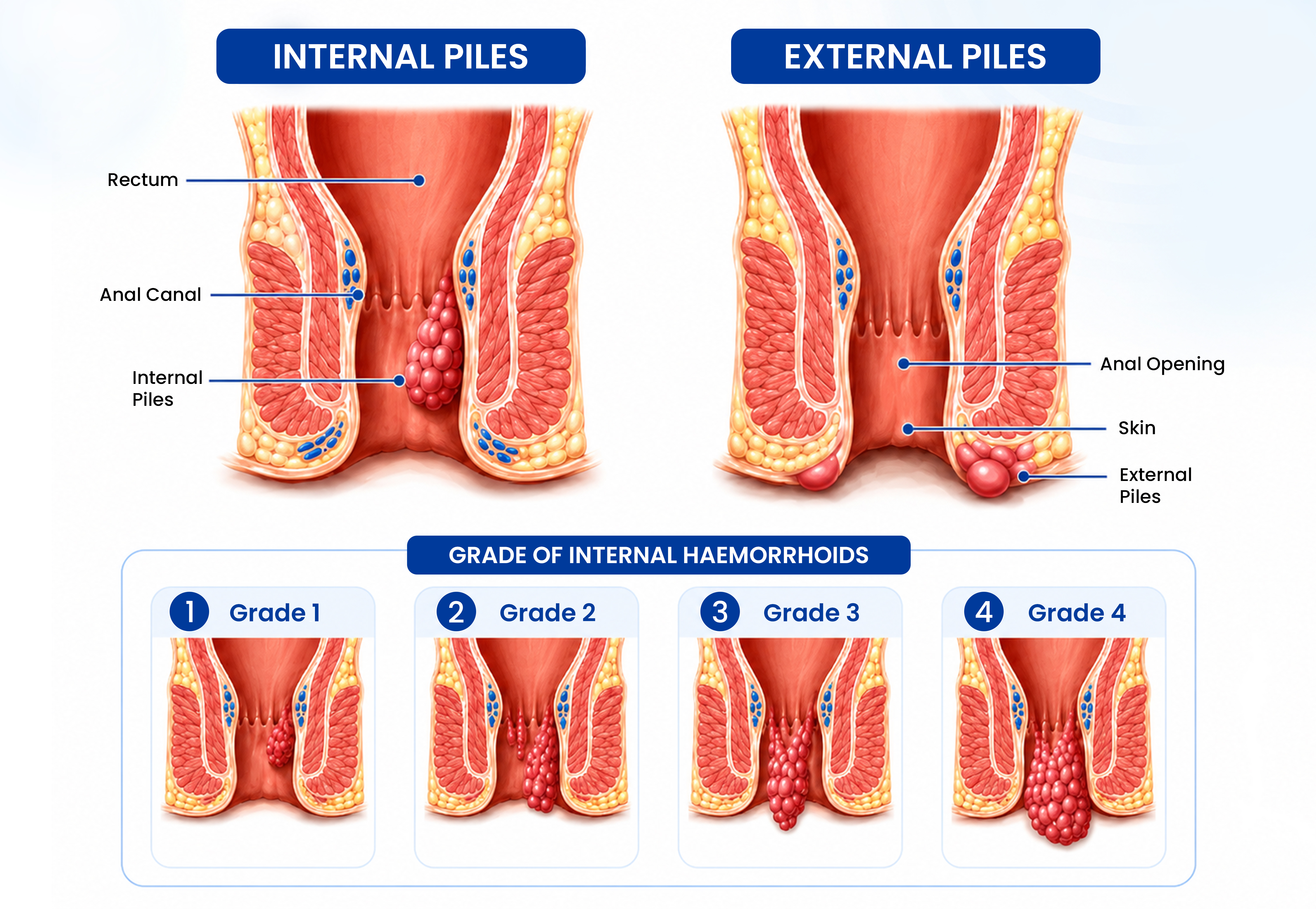
Internal piles form inside the rectal lining, above the dentate line. Because this area has very few pain nerve endings, they are often painless — but they bleed. You may notice bright red blood on tissue paper or in the toilet bowl. In more advanced stages, they begin to prolapse (push out) during bowel movements.
External piles develop beneath the skin around the anus — an area rich in nerve supply — and these hurt. Swelling, burning, a painful lump, and worsening discomfort when sitting are typical signs. When a blood clot develops inside an external pile (called a thrombosed haemorrhoid), the pain can become sudden and severe.
Common Causes of Piles
- Chronic constipation or habitual straining during bowel movements
- Low-fibre diet and inadequate fluid intake
- Prolonged sitting — especially on the toilet
- Sedentary lifestyle or desk-bound work
- Pregnancy and post-delivery pressure
- Obesity or regularly lifting heavy weights
- Family history of haemorrhoids
Understanding the root cause matters for treatment — because addressing only the piles without fixing the underlying trigger leads to recurrence.
Grades of Piles: Why Getting Your Grade Right Matters
One of the most important things we do at our Rohini piles clinic during a first consultation is classify the condition accurately. The grade directly determines what treatment is appropriate — and whether surgery is even necessary.
Grade I — Bleeding Without Prolapse
Internal haemorrhoids bleed during bowel movements but remain completely inside the anal canal. No lump is visible or felt. At this stage, conservative management — dietary changes, increased hydration, and medication — is almost always sufficient.
Grade II — Prolapse That Self-Reduces
The pile protrudes during straining but returns inside on its own afterwards. Grade II piles respond very well to outpatient procedures like Infrared Coagulation (IRC) or Laser Haemorrhoidoplasty (LHP).
Grade III — Prolapse Requiring Manual Reduction
The pile comes out during a bowel movement and must be pushed back in manually. At this stage, laser treatment may be recommended depending on the patient's condition.
Grade IV — Permanent Prolapse
The pile remains permanently outside the anal canal and cannot be manually reduced. An examination is required to determine the appropriate treatment plan.
Important: Rectal bleeding should never be self-diagnosed as piles. Other conditions — including polyps, fissures, and in rarer cases colorectal disease — can cause identical symptoms. A proper examination is essential.
Piles Treatment Options at Goyal Piles Laser Centre, Rohini
We offer a full range of piles treatments — from conservative management for early-stage cases to advanced laser procedures and surgical options for Grade III and IV piles. Every treatment plan is determined after a personal examination by Dr. Sushil Goyal.
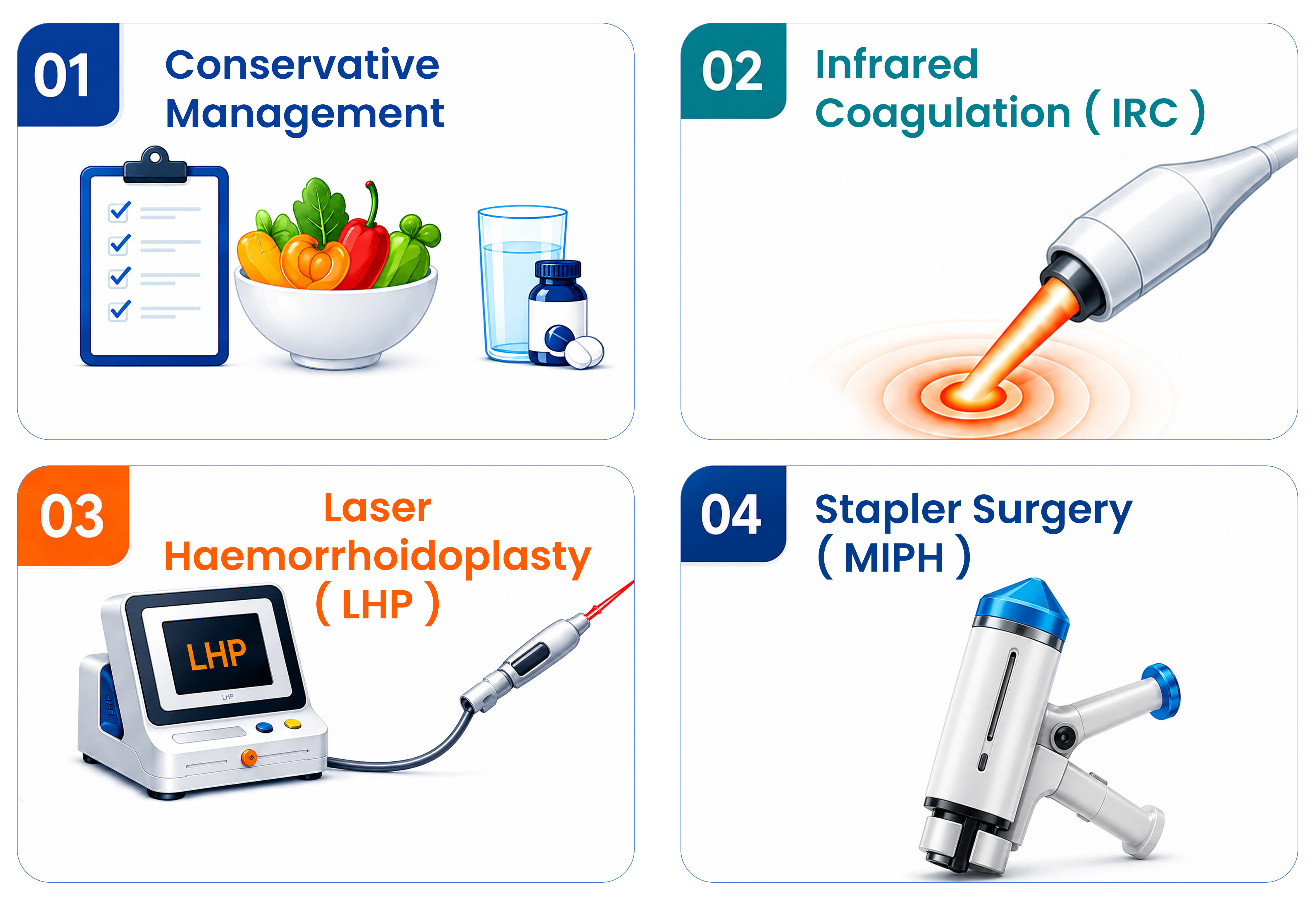
1. Conservative Management (Grade I and Early Grade II)
- High-fibre diet — whole grains, lentils, fruits, and vegetables
- Adequate fluid intake — a minimum of 2–3 litres of water daily
- Stool softeners if dietary changes alone are insufficient
- Sitz baths — warm water soaks for 10–15 minutes, 2–3 times a day
- Topical medicated creams to relieve itching and swelling
2. Infrared Coagulation (IRC) — Grade I and II
Infrared Coagulation is an outpatient procedure in which pulses of infrared light are directed at the base of internal haemorrhoids. The heat coagulates the blood vessels supplying the pile, cutting off its blood supply. Discomfort and recovery vary between patients.
3. Laser Haemorrhoidoplasty (LHP) — Grade II and III
Laser Haemorrhoidoplasty is a minimally invasive treatment option performed at Goyal Piles Laser Centre in Rohini. A specialised laser fibre is introduced through the natural anal opening and laser energy is delivered into the haemorrhoidal tissue. Suitability, risks and recovery depend on the case and should be discussed with the treating clinician.
4. Laser Treatment — Grade III and IV
Laser treatment is a minimally invasive option for suitable Grade III and IV presentations. The exact treatment plan is confirmed after examination.
5. Advanced Treatment — Complex Cases
For complex Grade IV piles, Dr. Sushil Goyal will explain the appropriate treatment plan after a detailed examination.
Why Choose Goyal Piles Laser Centre in Rohini?
There are several piles clinics in Delhi. At Goyal Piles Laser Centre, patients can discuss the available treatment options and the doctor's experience before deciding on care.
- 37+ Years of Dedicated Proctology Practice: Dr. Sushil Goyal has been treating anorectal conditions since 1989.
- Global Excellence Award 2019: Goyal Piles Laser Centre reports receiving this award.
- Patient volume: The centre reports treating more than 1 lakh patients from Rohini and other areas of Delhi and NCR.
- Treatment options: Conservative care, IRC and laser treatment are available.
- Consultation: Diagnosis, treatment options and costs can be discussed before deciding on care.
- Conveniently Located: D-12/182, First Floor, Sector 8, Rohini — near Rohini East Metro Station.
What Happens at Your First Consultation?
Many people delay visiting a piles clinic in Rohini because they are unsure what the examination involves. Here is exactly what to expect at Goyal Piles Laser Centre:
Clinical History: Dr. Goyal will ask about your symptoms — bleeding, pain, prolapse, itching, duration — and your bowel habits, diet, and any previous treatment.
Physical Examination: A perianal examination assesses external piles. For internal piles, a proctoscopy is performed to view the rectal lining directly. The procedure takes under a minute and causes pressure rather than pain in most patients.
Diagnosis and Grading: Based on the examination, Dr. Goyal will tell you your grade and explain what it means for your treatment options.
Treatment Discussion: You will receive a clear recommendation with the reasoning behind it, the expected procedure, recovery time, and approximate cost — all before any decision is made.
Cost of Piles Treatment in Rohini — What to Expect
Costs vary based on the procedure recommended, and we provide clear estimates before any treatment. As a general reference:
| Treatment | Approximate Cost Range |
|---|---|
| Consultation | ₹1,500 |
| IRC Treatment | ₹30,000 – ₹35,000 |
| Laser Treatment | ₹50,000 – ₹60,000 |
When Should You Stop Waiting and See a Doctor?
Visit a piles specialist without delay if you experience:
- Rectal bleeding lasting more than 3 days, even if painless
- A lump that does not reduce on its own after passing stools
- Sudden, sharp anal pain
- Faecal soiling of undergarments
- Bleeding that is heavy, dark, or clot-containing
- Symptoms that improve with home remedies but keep returning
Frequently Asked Questions
Is laser piles treatment painful? Pain and discomfort vary by patient and procedure. Ask the treating clinician what to expect for your condition and how discomfort will be managed.
How many days rest is needed after laser piles treatment in Rohini? Recovery and return to work depend on the procedure and individual circumstances. Follow the treating clinician's advice.
Can Grade III piles be treated without surgery? In many Grade III cases, yes. Laser treatment can be effective when confirmed suitable after examination.
Will piles come back after treatment? Recurrence is possible if lifestyle factors are not corrected. Patients who continue straining, eat a low-fibre diet, or remain sedentary are more likely to develop new haemorrhoids.
Is Goyal Piles Laser Centre open on Sundays? Our clinic operates Monday to Saturday. For appointment bookings and timings, please call +91-9999333166.
Conclusion: The Right Time to Act Is Now
Whether you are experiencing early-stage bleeding or a prolapsing pile that has been troubling you for months, the treatment path forward is clearer than most people expect. Piles at Grade I or II are straightforward to treat. Even Grade III cases can be handled with minimally invasive procedures that require a single day off work.
What changes things — for better or worse — is timing. The longer piles are left untreated, the higher the grade progresses, and the more involved the required treatment becomes.
At Goyal Piles Laser Centre in Rohini, your first consultation is a conversation — not a commitment. Dr. Sushil Goyal will examine your condition, explain your options honestly, and let you decide what is right for you.
This content is for informational purposes only. Please consult Dr. Sushil Goyal or a qualified medical professional for diagnosis and personalised treatment advice.
📍 D-12/182, First Floor, Sai Baba Chowk, Sector 8, Rohini — Near Rohini East Metro Station
📞 Call or WhatsApp: +91-9999333166
→ Also read: Anal Fissure Treatment in Rohini | Fistula Treatment | Pilonidal Sinus Treatment
