Piles Treatment for Women in Rohini, Delhi — What to Expect, When to Seek Help, and Why It's More Common Than You Think
If you are a woman in Rohini or North Delhi dealing with bleeding, pain, or discomfort in the anal area — and you have been putting off seeing a doctor about it — you are not alone. And your reasons for delaying are completely understandable.
Many women tolerate piles for months or years before seeking help. Some attribute their symptoms to gynaecological causes and never get an accurate diagnosis. Others know what the problem is but find the idea of a consultation uncomfortable to contemplate. A few have been told by friends or family that "it will go away on its own" — and waited to see if that turns out to be true.
This article is written for you. It covers why women are particularly susceptible to piles, what the consultation actually involves, when to stop waiting and seek treatment, and what your options are at Goyal Piles Care Centre in Rohini — where Dr. Sushil Goyal has been treating female patients across all life stages for 37 years.
Why Women Are More Likely to Develop Piles Than Most People Realise
Piles are generally thought of as a condition driven by lifestyle — constipation, low fibre, sitting too long. And those factors apply equally to men and women. But women have several additional biological triggers that men simply do not have.
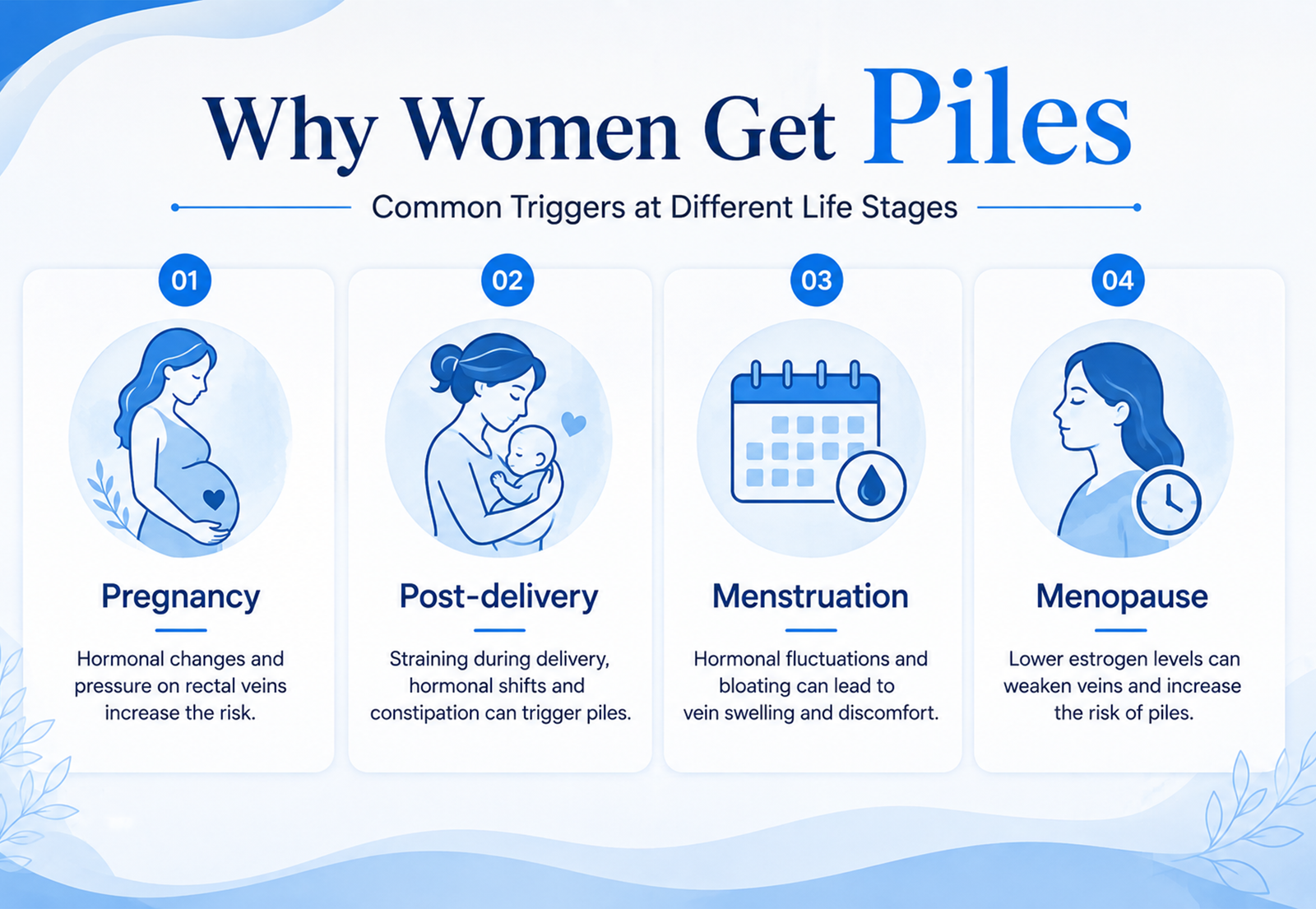
Pregnancy
Pregnancy is the most significant female-specific cause of haemorrhoids. Two mechanisms act simultaneously: as the uterus grows, it compresses the pelvic veins and rectum, restricting blood return and causing the rectal vessels to engorge. At the same time, elevated progesterone during pregnancy relaxes the walls of blood vessels, making them more susceptible to swelling and displacement.
Constipation — extremely common during pregnancy due to hormonal changes, reduced activity, and iron supplementation — compounds the problem. Straining during childbirth itself puts enormous pressure on the pelvic floor and rectal vessels, which is why piles that were mild during pregnancy often worsen significantly immediately after delivery.
Post-Delivery Period
The first few weeks after delivery are a particularly vulnerable time. Straining during labour, perineal trauma, and postpartum constipation (often worsened by pain medications and reduced mobility) combine to make haemorrhoids very common in new mothers. Many women assume post-delivery anorectal symptoms are a normal part of postpartum recovery and never seek an assessment.
Menstrual Cycle
Hormonal fluctuations during menstruation affect vein tone throughout the body — including the rectal vessels. Many women notice that piles symptoms worsen predictably in the days before or during their period. This pattern is recognised but underreported because women often do not connect the two.
Menopause
After menopause, oestrogen decline reduces the elasticity of blood vessel walls and connective tissue throughout the body. Constipation becomes more common as bowel motility slows. The combination creates a physiological environment in which haemorrhoids can develop or worsen — even in women who had no piles-related problems before menopause.
Chronic Constipation
Women have a higher baseline rate of constipation than men — driven by slower colonic transit time, dietary patterns, and the hormonal influences described above. Chronic constipation is the single most common underlying cause of piles across all patient groups, and it disproportionately affects women.
Are Your Symptoms Piles — Or Something Else?
One reason female patients delay seeking help is that anorectal bleeding and discomfort are sometimes attributed to gynaecological causes. This is understandable — the symptoms can overlap. But piles have specific characteristics that distinguish them:
Piles are likely if:
- Bright red blood appears on tissue paper or in the toilet bowl after a bowel movement
- There is itching, moisture, or a feeling of something protruding near the anus
- Discomfort increases with straining and improves at rest
- Symptoms worsen during or after pregnancy
Seek immediate assessment if:
- Bleeding is dark, heavy, or mixed with stool
- You have unexplained weight loss, change in bowel habits, or abdominal pain alongside rectal bleeding
- Symptoms appeared suddenly and are worsening rapidly
Rectal bleeding in women should never be automatically attributed to piles or to gynaecological causes without an examination. A proper clinical assessment distinguishes between the two and rules out other causes. At Goyal Piles Care Centre, many female patients tell us they assumed their symptoms were gynaecological for months before finally getting a correct diagnosis.
What the Consultation Actually Involves — Addressed Directly
This is the most commonly unspoken concern — and it deserves a direct, honest answer.
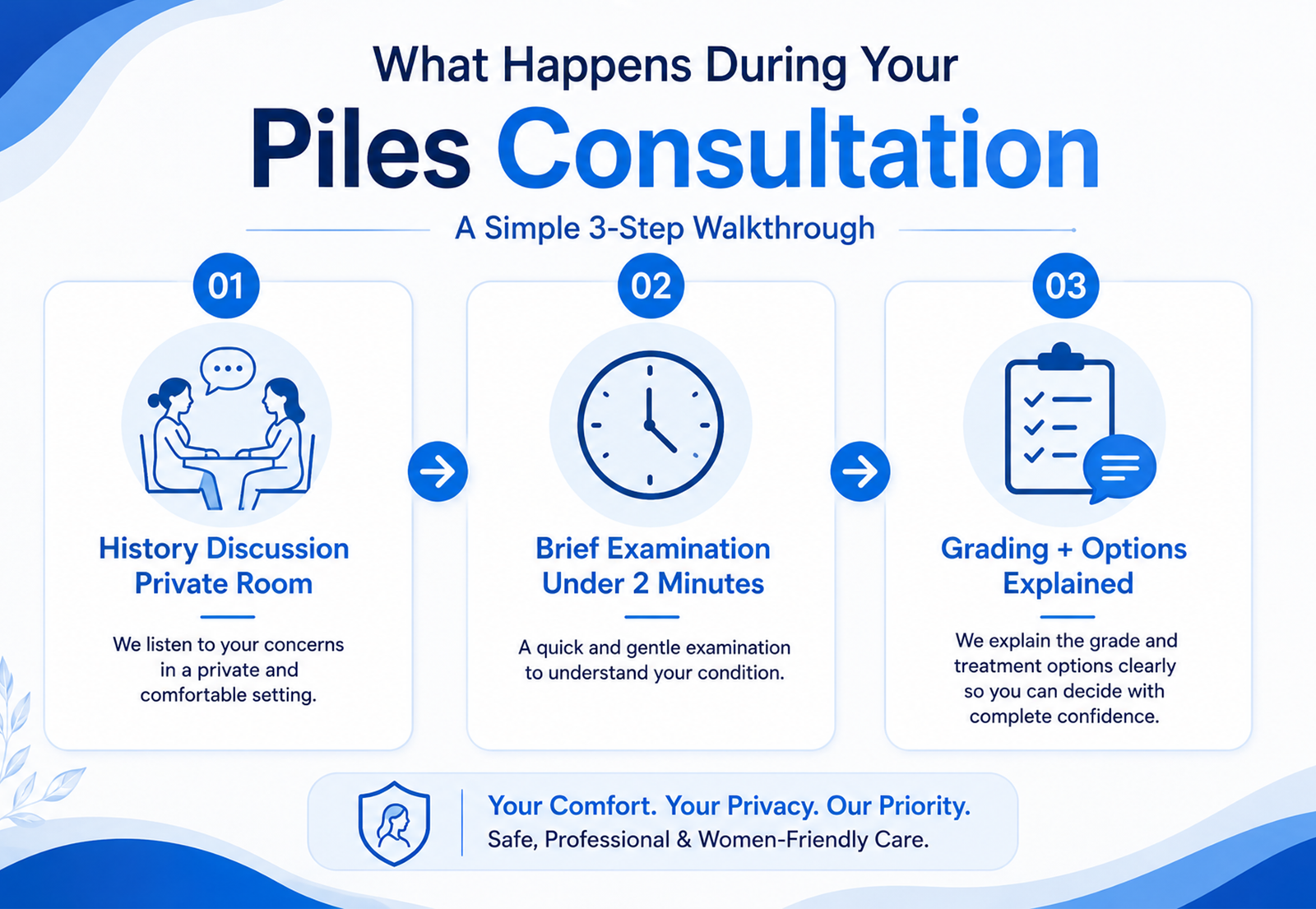
The consultation at Goyal Piles Care Centre begins with a clinical history discussion. Dr. Sushil Goyal will ask about your symptoms, their duration, your bowel habits, and your pregnancy and delivery history if relevant. This is a routine clinical conversation, conducted with complete discretion in a private consulting room.
The physical examination involves a visual inspection of the perianal area to assess external haemorrhoids, followed by a proctoscopy — a brief examination using a small, lighted instrument to view internal haemorrhoids. The examination takes under two minutes. The sensation is one of mild pressure rather than pain in the absence of active inflammation.
The examination is a clinical procedure — routine, professional, and managed with the same standard of care given to every patient. Thousands of female patients have had this assessment at Goyal Piles Care Centre over 37 years. Many describe the consultation as considerably less uncomfortable than they had anticipated.
If at any point during the examination you feel significant discomfort, you can ask for a pause. The procedure is not proceeded with in the face of acute distress.
Treatment Options for Women — Including During and After Pregnancy
During Pregnancy
Treatment during pregnancy is primarily conservative and focuses on symptom management rather than definitive intervention. This is the internationally recommended approach for pregnancy-related haemorrhoids.
Conservative management during pregnancy:
- High-fibre diet and adequate hydration to soften stools
- Warm sitz baths for 10–15 minutes, 2–3 times daily
- Topical anaesthetic preparations for symptomatic relief, as approved by your obstetrician
- Avoiding prolonged standing or sitting
Most haemorrhoids that develop during pregnancy improve after delivery with conservative management. The key is not allowing constipation and straining to worsen them further during the pregnancy itself.
Post-Delivery
For piles that develop or worsen after delivery, conservative management continues for the first 6–8 weeks while the body recovers from childbirth. If symptoms persist beyond this period — or if bleeding, prolapse, or pain remain significant — a proper assessment and potentially a procedure may be appropriate.
IRC (Infrared Coagulation) is particularly well-suited for post-delivery patients. It requires no anaesthesia, takes 10 minutes, and allows same-day return to normal activity — including caring for a newborn. Learn more about IRC treatment at our Rohini clinic.
Breastfeeding mothers: any topical or oral medication must be reviewed against breastfeeding safety. At Goyal Piles Care Centre, Dr. Sushil Goyal will always confirm medication safety for breastfeeding patients before prescribing.
For Women Who Are Not Pregnant
The full range of piles treatments is available — matching the grade of haemorrhoids confirmed at examination:
Grade I–II: IRC or Laser Haemorrhoidoplasty (day care, no anaesthesia for IRC, minimal for laser)
Grade III: Laser Treatment after examination
Grade IV: Examination-based treatment plan
Read our full piles treatment options guide for a detailed comparison.
When to Stop Waiting and Seek an Assessment
If any of the following apply, do not delay further:
- You have had rectal bleeding for more than 2–3 weeks
- Symptoms are worsening rather than improving
- You are post-delivery and piles symptoms have persisted beyond 8 weeks
- Pain is affecting daily activities, sleep, or your ability to care for a child
- You feel embarrassed about the symptom but sense it is getting worse — not better
- Your symptoms disappeared and have now returned
One thing worth saying plainly: the embarrassment you feel about this condition is completely understandable — and completely shared by the vast majority of women who walk through our door. Every patient who has managed to book an appointment has told us, at some point, that they wished they had come sooner. The examination is brief, professional, and handled with dignity. The treatments available are effective and, for most women, require no hospital stay.
Frequently Asked Questions
Q: Can I have piles treatment while breastfeeding?
IRC and examination are safe during breastfeeding. Any medication prescribed will be reviewed for breastfeeding compatibility by Dr. Sushil Goyal before it is given. Laser procedures under local anaesthesia are generally considered safe but timing is usually discussed on a case-by-case basis depending on the clinical need.
Q: My piles developed during pregnancy. Will they go away after delivery?
Many pregnancy-related haemorrhoids improve significantly after delivery with conservative management — fibre, hydration, and sitz baths. However, Grade III or IV haemorrhoids, or those that remain symptomatic beyond 6–8 weeks post-delivery, are unlikely to resolve without treatment. A proper examination after this period clarifies what intervention, if any, is needed.
Q: I am post-menopausal and have started experiencing symptoms. Is this related?
Yes — post-menopausal changes in vein tone, colonic transit time, and constipation frequency all increase haemorrhoidal risk. Piles developing in post-menopausal women are entirely treatable and should not be attributed to age and accepted as inevitable. An examination will confirm the grade and the appropriate treatment.
Q: I am worried the examination will be very uncomfortable. Is it?
The proctoscopy examination takes under two minutes and causes mild pressure rather than pain in most patients. Women who have been examined at Goyal Piles Care Centre consistently describe it as considerably less uncomfortable than they anticipated. Dr. Sushil Goyal will explain each step before it happens and will pause at any point if you need a moment.
Goyal Piles Care Centre — Treating Women in Rohini Since 1989
Over 37 years of practice in Rohini, Dr. Sushil Goyal has treated female patients across every life stage — young women, pregnant women, new mothers, and post-menopausal patients. The consultation room is private, the examination is professional, and the treatment is matched precisely to the grade of the condition.
Thousands of women across Rohini, Pitampura, Shalimar Bagh, and Prashant Vihar have received treatment here. Many came after months or years of delay. All of them found the consultation itself far less daunting than they had expected.
📍 D-12/182, First Floor, Sector 8, Rohini, Delhi – 110085
Near Rohini East Metro Station Gate 2 | Opposite Metro Pillar No. 393
📞 Call or WhatsApp: +91-9999333166
Monday to Saturday | 9:30 AM to 1:30 PM
→ All piles treatment options → IRC — no anaesthesia, same day return → Diet after piles treatment
Written by Dr. Sushil Goyal, MBBS, FCGP — Piles and Anorectal Specialist, Goyal Piles Care Centre, Rohini, Delhi. Last reviewed: July 2026.
This article is for informational purposes only and does not constitute medical advice. Please consult a qualified medical professional for diagnosis and personalised treatment.
