Piles Home Remedies — What Actually Works and What Doesn't
Every article about piles home remedies lists the same things: warm sitz baths, high-fibre diet, aloe vera, coconut oil, witch hazel. Some of them are genuinely useful. Some are mildly helpful for symptom relief. Some are completely ineffective. And some can delay proper treatment long enough for a Grade I haemorrhoid to become a Grade III.
After 37 years of treating piles at Goyal Piles Care Centre in Rohini, Dr. Sushil Goyal has seen the full spectrum — patients who successfully managed Grade I piles with dietary change alone, and patients who spent six months applying coconut oil to a Grade III haemorrhoid that needed laser surgery from the beginning.
This article gives you the honest version: what home remedies actually do, which grade of piles they can genuinely manage, and the signals that tell you when home remedies are no longer the right approach.
The Most Important Thing to Understand First — Grade Determines Everything
Before any home remedy discussion is useful, you need to understand that the grade of your haemorrhoid determines what is possible:
Grade I — small internal haemorrhoid, bleeds but stays inside. Home remedies genuinely can resolve this — permanently, if dietary changes are maintained.
Grade II — haemorrhoid prolapses during bowel movement but returns inside on its own. Home remedies relieve symptoms temporarily. They cannot reduce the prolapse or restore structural integrity. IRC or laser is required for permanent resolution.
Grade III — haemorrhoid must be manually pushed back inside. Home remedies provide temporary comfort only. Laser or stapler surgery is required.
Grade IV — permanently prolapsed. Surgical treatment is required.
Grade 1 and many Grade 2 piles can be controlled long term and often settle completely with a high-fibre diet, plenty of water, sitz baths and avoiding straining. Advanced Grade 3 and Grade 4 piles usually need a medical procedure — home remedies control symptoms rather than cure them.
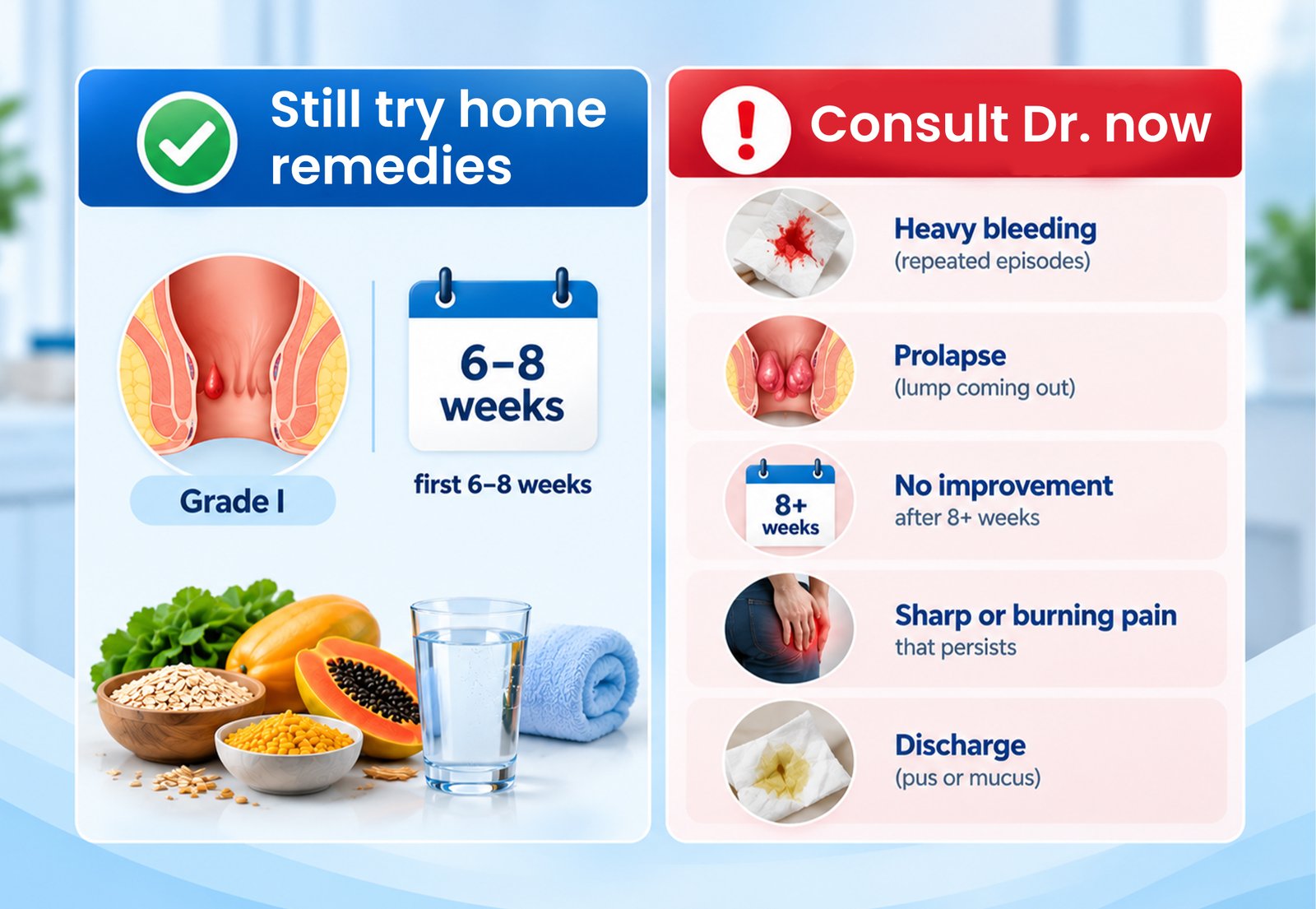
The most common mistake in piles self-management: applying Grade I home remedy logic to a Grade III situation. If you have been using home remedies for more than 6–8 weeks without clear improvement, your grade is very likely beyond what home remedies can address.
What Actually Works — Evidence-Based Home Remedies
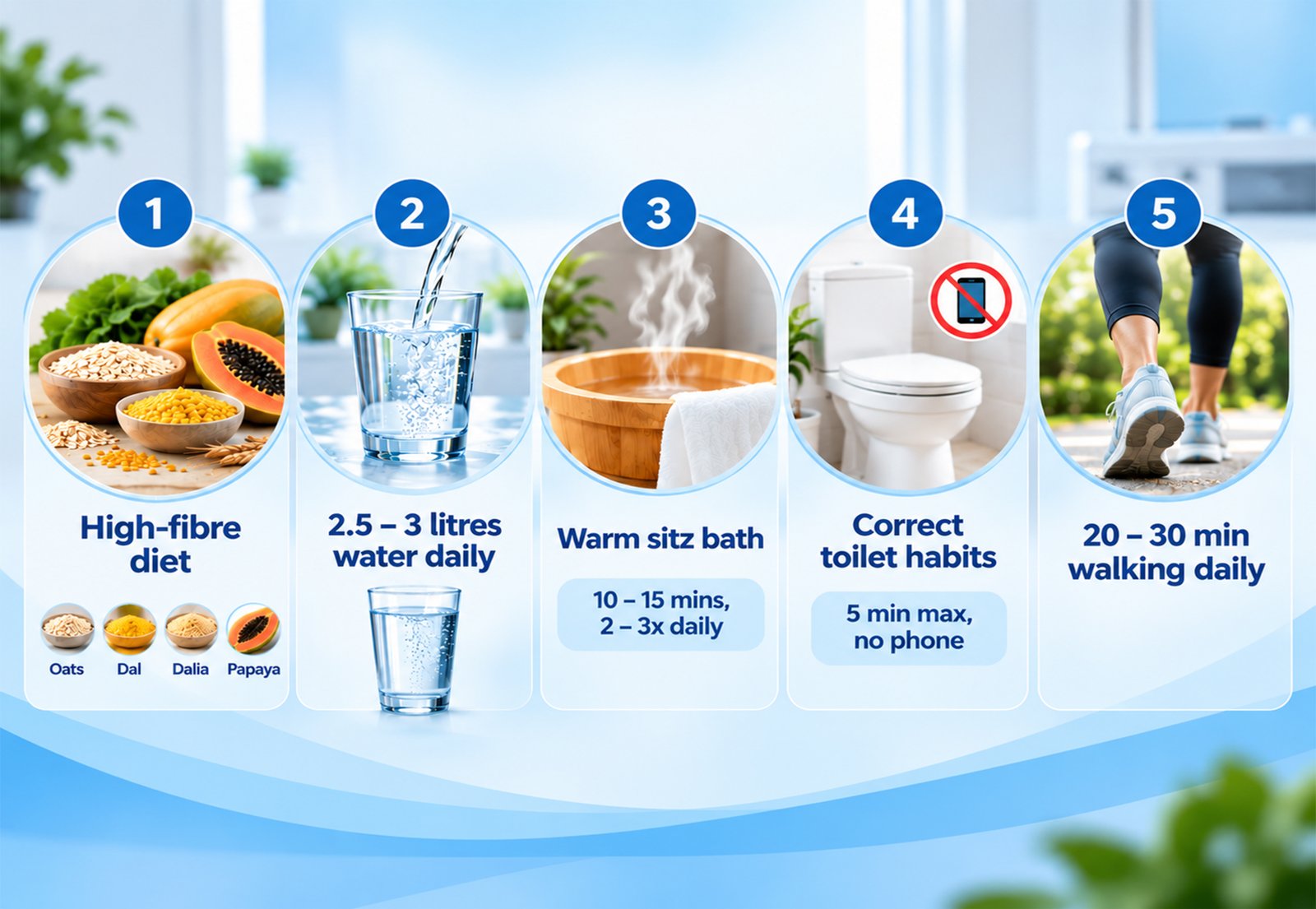
1. High-Fibre Diet — The Most Important Intervention
This is not optional — it is the single most effective home measure for piles, and the one most patients do incompletely.
The single most effective home measure for piles is a high-fibre diet with plenty of water, because it keeps stools soft and stops the straining that causes and worsens piles.
Why it works: Hard stools require straining. Straining increases pressure inside the rectal veins with every bowel movement. Over weeks and months, this pressure is what causes haemorrhoidal vessels to swell. Soft, bulky stools pass without straining, removing the primary mechanical trigger.
What works for Indian patients specifically:
- Dalia (broken wheat) porridge — 1 bowl every morning. High fibre, easy to prepare, highly effective
- Moong dal, masoor dal, chana dal — daily, at lunch or dinner
- Papaya — one serving daily. Natural papain enzyme supports digestion alongside the fibre
- Lauki (bottle gourd) — cooked, at any meal. High water content, gentle on digestion
- Oats — morning breakfast, with water or milk
- Ripe banana — one daily. Soluble fibre
- Isabgol (psyllium husk) — one teaspoon in warm water at bedtime. The most reliable fibre supplement available in India
What does not help: White rice, maida (refined flour), processed foods, instant noodles. These are low-fibre and worsen constipation.
The quantity that matters: 25–35 grams of dietary fibre daily. Most Indians consume 10–12 grams. The gap between current intake and therapeutic intake is substantial — changes must be significant, not token additions.
Duration: Permanent. Not a 6-week post-procedure protocol. A permanent change in eating habits is what makes dietary management work for Grade I and what prevents recurrence after any procedure.
2. Adequate Hydration — Fibre's Essential Partner
Drinking 2 to 3 litres of water a day keeps stool soft and easy to pass.
Fibre without water compacts rather than bulking. Many patients increase their fibre intake and then wonder why stools are harder than before — the fibre is drawing water from the colon without sufficient replacement. The result is denser, harder stools.
What works: 2.5–3 litres of water daily. Plain water — not chai, not soft drinks, not packaged juices. These contain sugar and other components that do not contribute to stool softening the same way plain water does.
For elderly patients and those with cardiac or renal conditions: Check with your physician for appropriate fluid restriction before increasing water intake significantly.
3. Warm Sitz Bath — Proven Symptom Relief
A sitz bath — sitting in warm water for 10–15 minutes — is one of the most reliably effective home measures for immediate symptom relief.
Why it works: Warm water increases blood flow to the inflamed haemorrhoidal tissue, reduces the reflex spasm of the internal anal sphincter, and decreases swelling. (cite index="21-1">A sitz bath taken by soaking the anal area in warm water for about 15 minutes, 3 times a day or after every bowel movement can greatly help reduce swelling related to piles.
How to do it correctly:
- Warm water — not hot. Hot water causes vasoconstriction and can worsen symptoms
- 10–15 minutes per session
- 2–3 times daily, or after each bowel movement
- No soap, no chemicals unless specifically prescribed by Dr. Sushil Goyal
- Pat dry gently — do not rub
A sitz bath relieves symptoms — it does not shrink or remove haemorrhoidal tissue. For Grade I, combined with dietary change, this is often sufficient for long-term management. For Grade II and above, it provides comfort alongside the treatment that actually addresses the haemorrhoid.
4. Correct Toilet Habits — Often Overlooked
Do not strain, do not sit long on the toilet. Not straining and not sitting long on the toilet reduces pressure on anal veins.
What the correct toilet habit looks like:
- Respond to the toilet urge within 5–10 minutes of feeling it — do not delay
- Sit for no more than 5 minutes
- Do not strain or bear down forcefully
- No phone, no newspaper, no book on the toilet — these extend the sitting duration without conscious awareness
- If nothing happens within 5 minutes, leave and return when the urge is genuinely present again
Why this matters: Prolonged sitting on the toilet increases pelvic venous pressure even without active straining. The squatting position is more physiologically appropriate for defecation than the Western toilet posture — many patients benefit from a small footstool under their feet to raise the knees slightly and approximate a partial squat.
5. Regular Physical Activity
Twenty to thirty minutes of walking daily maintains bowel motility — the rhythmic muscular contractions that move contents through the colon. Sedentary days directly increase constipation risk.
Walking does not need to be intense. A consistent daily walk at any pace is sufficient. This is one of the easiest and most reliable ways to prevent constipation and reduce haemorrhoid flare-ups over time.
What Provides Temporary Relief Only
These measures reduce discomfort but do not address the haemorrhoidal tissue itself:
Topical OTC Creams and Ointments
Piles creams — lidocaine-based anaesthetics, hydrocortisone preparations, witch hazel preparations — reduce itching, burning, and local inflammation temporarily. They do not shrink haemorrhoidal tissue, do not stop bleeding permanently, and do not prevent prolapse.
Appropriate use: Short-term symptom relief while dietary changes take effect for Grade I. Not appropriate as a long-term management strategy for Grade II and above — and not appropriate as a substitute for clinical assessment.
Duration limit: No OTC piles cream should be used for more than 2–3 weeks without a clinical review. Hydrocortisone preparations in particular should not be used long-term as they cause perianal skin thinning.
Cold Compress
A cold pack applied briefly (5–10 minutes) to the external area reduces acute swelling and provides immediate numbing relief. Particularly useful for thrombosed external haemorrhoids in the first 24 hours.
What it does not do: It does not reduce internal haemorrhoidal tissue. Use cold initially, then transition to warm sitz baths from 24 hours onward.
What Does Not Work for Piles — Honest Assessment
Coconut Oil Applied Topically
Coconut oil applied to the perianal area has mild moisturising and anti-inflammatory properties that reduce external irritation. It has no effect on internal haemorrhoids — which is where most of the pathology sits for Grade I and II. It does not shrink vessels, stop bleeding, or address prolapse. Applying coconut oil reduces irritation and swelling. — this refers to external discomfort only, not haemorrhoidal tissue itself.
Aloe Vera Gel
Aloe vera gel applied externally soothes irritated perianal skin. Like coconut oil, this is symptom management for external discomfort — it has no effect on the haemorrhoidal vessels themselves.
Radish Juice, Apple Cider Vinegar, Garlic
These are traditional remedies with no clinical evidence for piles management. They may have general digestive benefits but there is no mechanism by which they address swollen rectal vessels. Some — particularly apple cider vinegar applied topically — can cause chemical burns on already-irritated perianal skin.
"3-Day Cure" Claims
Any article or product claiming to cure piles in 3 days is misleading. Mild external swellings and Grade 1 to 2 internal piles often shrink noticeably in 2–4 weeks with consistent high-fibre diet and sitz baths. Even the most effective conservative approach takes 4–8 weeks to show clear improvement in Grade I. Grade II and above requires a procedure.
When Home Remedies Are No Longer Enough — The Signs
This is the most practically important section of this article. Recognising when to move from home management to specialist assessment is what separates a patient who treats their condition early and simply from one who presents with Grade III haemorrhoids after 8 months of coconut oil.
See Dr. Sushil Goyal at Goyal Piles Care Centre if:
- Symptoms have not improved after 6–8 weeks of consistent high-fibre diet, adequate hydration, and sitz baths
- Bleeding is heavy — more than minor spotting on tissue paper
- A lump near the anus does not return inside on its own after a bowel movement
- Pain is severe — sharp, burning pain that lasts 30+ minutes after a bowel movement (this suggests a fissure, not piles)
- Discharge from near the anus that is not bleeding — pus, mucus, foul-smelling (possible fistula)
- Symptoms keep returning each time dietary measures are relaxed
- You have not yet seen a doctor and do not actually know your grade
Home Remedies by Grade — Quick Reference
Grade
What Home Remedies Can Do
What They Cannot Do
Grade I
Permanently resolve with consistent diet change + sitz baths + correct toilet habits
—
Grade II
Relieve symptoms temporarily, prevent worsening
Reduce prolapse, permanently stop bleeding
Grade III
Provide comfort between treatments
Address prolapse, replace IRC or laser
Grade IV
Minimal symptom comfort only
Replace surgical treatment
Frequently Asked Questions
Q: Can piles be cured permanently with home remedies? For genuine Grade I haemorrhoids — yes. High-fibre diet, adequate hydration, correct toilet habits, and sitz baths maintained permanently can resolve Grade I haemorrhoids and keep them resolved. For Grade II and above, home remedies manage symptoms but cannot permanently cure the condition. The haemorrhoidal tissue that has prolapsed or enlarged requires IRC, laser, or surgery.
Q: How long should I try home remedies before seeing a doctor? Six to eight weeks of consistent, genuine effort — meaning daily sitz baths, 25–35 grams of fibre daily, 2.5–3 litres of water, and correct toilet habits. If there is no clear improvement after this period, a specialist assessment is needed. Do not delay beyond 8 weeks — earlier assessment means simpler treatment.
Q: Is coconut oil effective for piles? Coconut oil reduces external irritation and moisturises inflamed perianal skin. It has no effect on haemorrhoidal vessels, does not stop bleeding from internal haemorrhoids, and does not address prolapse. It is a comfort measure — not a treatment.
Q: Can I use OTC piles cream long-term? No — OTC piles creams should not be used for more than 2–3 weeks without medical review. Hydrocortisone-containing creams cause perianal skin thinning with prolonged use. Anaesthetic creams mask symptoms without addressing the underlying condition. If you have been using OTC cream for more than 3–4 weeks, a clinical assessment is overdue.
Q: What is the best home remedy for piles in India? The most effective home intervention for piles in India is a combined approach: dalia or oats breakfast daily, one serving of dal at lunch or dinner, one serving of papaya daily, 2.5–3 litres of water, warm sitz bath 2–3 times daily, and no phone or prolonged sitting on the toilet. This combination addresses the primary cause (constipation and straining) and provides symptomatic relief simultaneously.
When Home Remedies Have Not Been Enough — We Are Here
If you have been managing piles with home remedies and symptoms keep returning — or if you have never had a clinical examination to confirm what grade you actually have — a 20-minute appointment at Goyal Piles Care Centre in Rohini tells you everything you need to know.
Dr. Sushil Goyal, MBBS, FCGP — 37 years, 2 lakh+ patients treated — will examine your condition, confirm your grade, and tell you honestly whether continued home management is appropriate or whether a procedure will produce better results.
476 verified Google reviews at 4.7 stars. Global Excellence Award 2019 — Best Laser Centre in North India.
📍 D-12/182, First Floor, Sector 8, Rohini, Delhi – 110085 Near Rohini East Metro Station Gate 2 | Opposite Metro Pillar No. 393 📞 Call or WhatsApp: +91-9999333166 Monday to Saturday | 9:30 AM to 1:30 PM
This article is for informational purposes only and does not constitute medical advice. Please consult a qualified medical professional for diagnosis and personalised treatment.
