Piles After Delivery — Why They Get Worse and What New Mothers in Rohini Can Do

Having a baby is one of the most demanding physical experiences the body goes through. What many new mothers are not prepared for is what happens in the weeks after delivery — and why piles, which may have been mild or even unnoticed during pregnancy, can suddenly become significantly worse.
Approximately 25–35% of pregnant women develop piles during pregnancy, with the condition occurring most commonly during the third trimester and shortly after childbirth. If you are reading this article in the weeks after delivery — with bleeding, pain, or a lump near the anus that you are not sure how to manage while also caring for a newborn — this guide is specifically for you.
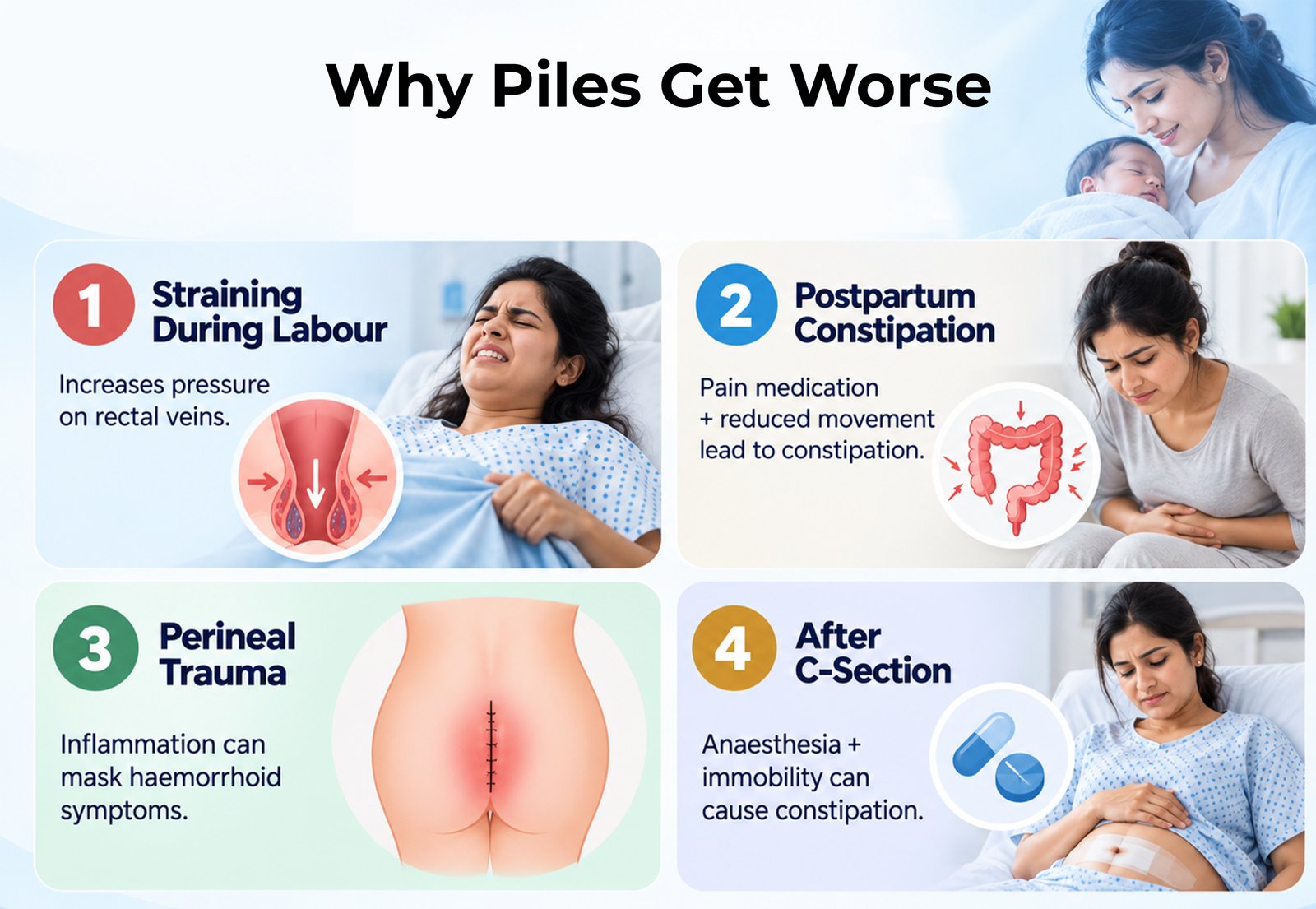
Why Piles Get Worse After Delivery — Not Better
Most new mothers assume that once the baby is born and the pressure of the uterus on the pelvis is removed, piles should improve. For some women with mild Grade I haemorrhoids, this does happen. But for many — particularly those who developed haemorrhoids in the third trimester or had a long or difficult labour — the delivery itself is a significant worsening event.
Here is why:
- Straining during childbirth: Vaginal delivery usually involves straining, which increases the pressure within the rectal veins. The pushing effort during the second stage of labour — which can last anywhere from 20 minutes to several hours — applies enormous sustained pressure on the pelvic floor and anorectal vessels. Haemorrhoids that were mild during pregnancy can prolapse, thrombose (clot), or enlarge significantly during this period.
- Postpartum constipation: In the first days after delivery, constipation is extremely common. Several factors combine: pain medications (particularly opioids given during or after labour) slow bowel motility significantly; fear of pain from perineal stitches makes women reluctant to strain; reduced activity in the first week slows digestion; and reduced fluid and fibre intake during hospital stay compounds all of the above. Constipation means hard stools, which means further straining, which further aggravates already-inflamed haemorrhoids.
- Perineal trauma: After a vaginal delivery — particularly if an episiotomy was performed or if there was a tear — the entire perineal area is inflamed, sore, and swollen. This makes it extremely difficult to distinguish what is haemorrhoidal swelling from what is general perineal oedema, and patients often assume everything they feel is "normal after childbirth" when it needs specific treatment.
- After C-section: Piles after C-section are also common — and often surprising to mothers who assumed they would avoid the problem by not having a vaginal delivery. The reasons: the hormonal changes of pregnancy (elevated progesterone relaxing vessel walls) are present equally regardless of delivery mode; constipation from anaesthesia, pain medications, and reduced mobility is often worse after C-section; and the pre-existing haemorrhoids from pregnancy remain.
What Symptoms Are Normal — and What Needs Assessment
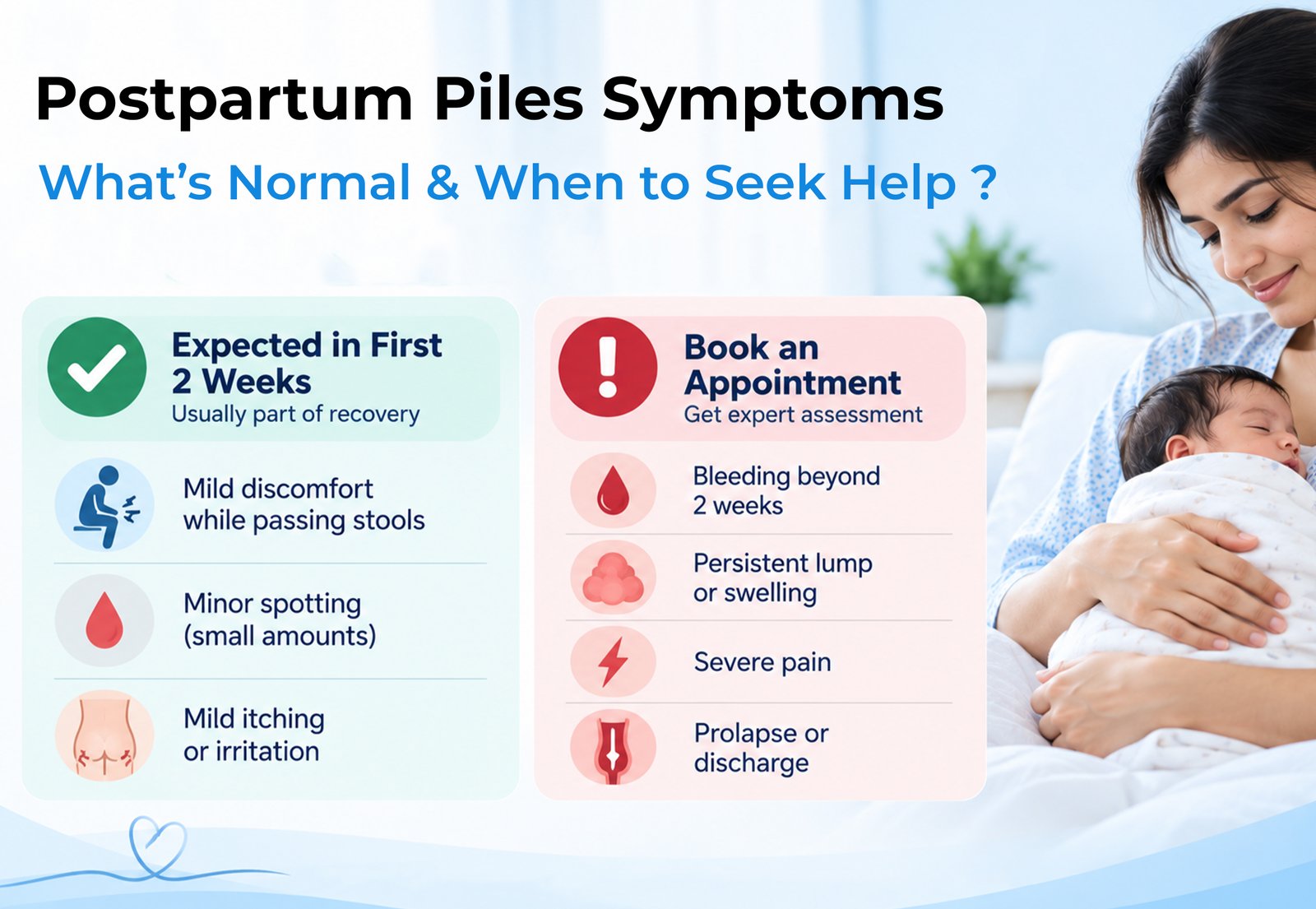
In the first 1–2 weeks after delivery, some degree of anorectal discomfort is common and expected. The challenge for new mothers is knowing what is within the range of normal postpartum recovery and what signals a haemorrhoidal problem that needs specialist attention.
Symptoms that are expected and usually settle with conservative care:
- Mild anorectal discomfort and a sensation of swelling that improves daily
- Minor spotting of bright red blood on tissue paper in the first few days
- Mild itching as perineal wounds begin healing
Symptoms that need assessment at Goyal Piles Care Centre:
- Bleeding that is more than minor spotting — or that continues beyond 2 weeks
- A distinct lump near the anus that is not reducing in size after 2 weeks
- Severe pain near the anus — especially a sudden-onset very painful swelling (possible thrombosed haemorrhoid — needs prompt treatment)
- Prolapse — a lump that comes out when you go to the toilet and does not return on its own
- Discharge or a foul-smelling sore near the anus (suggests fistula or abscess rather than haemorrhoid)
- Any symptom that is worsening rather than gradually improving after week 2
Safe Treatment Options for Postpartum Piles
The most important principle for treating piles after delivery: treatment must be safe during breastfeeding if you are nursing. Everything at Goyal Piles Care Centre is reviewed for breastfeeding compatibility before it is prescribed or recommended.
First 6–8 Weeks — Conservative Management
For most new mothers with Grade I or mild Grade II haemorrhoids, the first 6–8 weeks of conservative care is the right starting point:
- High-fibre diet: This is the single most important intervention. Soft, bulky stools that pass without straining are what protect healing haemorrhoidal tissue in the postpartum period. Indian foods that work well: dalia (broken wheat) as a morning porridge, moong dal daily, papaya, ripe banana, lauki (bottle gourd), and oats.
- Adequate hydration: 2.5–3 litres of water daily. This is especially important for breastfeeding mothers, who lose significant fluid through milk production. Dehydration is one of the most common drivers of postpartum constipation.
- Warm sitz baths: 10 minutes in warm water, 2–3 times daily. Reduces inflammation, relieves itching, and promotes blood flow to the healing area. Safe immediately after delivery once any perineal wound has begun closing.
- Prescribed topical preparations: Dr. Sushil Goyal will prescribe only preparations confirmed safe for breastfeeding. Do not use over-the-counter piles creams without checking with your doctor — some contain vasoconstrictors or local anaesthetics with limited breastfeeding safety data.
- Gentle movement: Even short walks of 10–15 minutes from Day 3–5 after delivery (if medically cleared) help restore bowel motility and reduce constipation.
When Conservative Care Is Not Enough — IRC After Delivery
If symptoms have not improved significantly by 6–8 weeks post-delivery — particularly persistent bleeding, a prolapsing lump, or significant discomfort — IRC (Infrared Coagulation) is the most appropriate next step for Grade I and Grade II haemorrhoids.
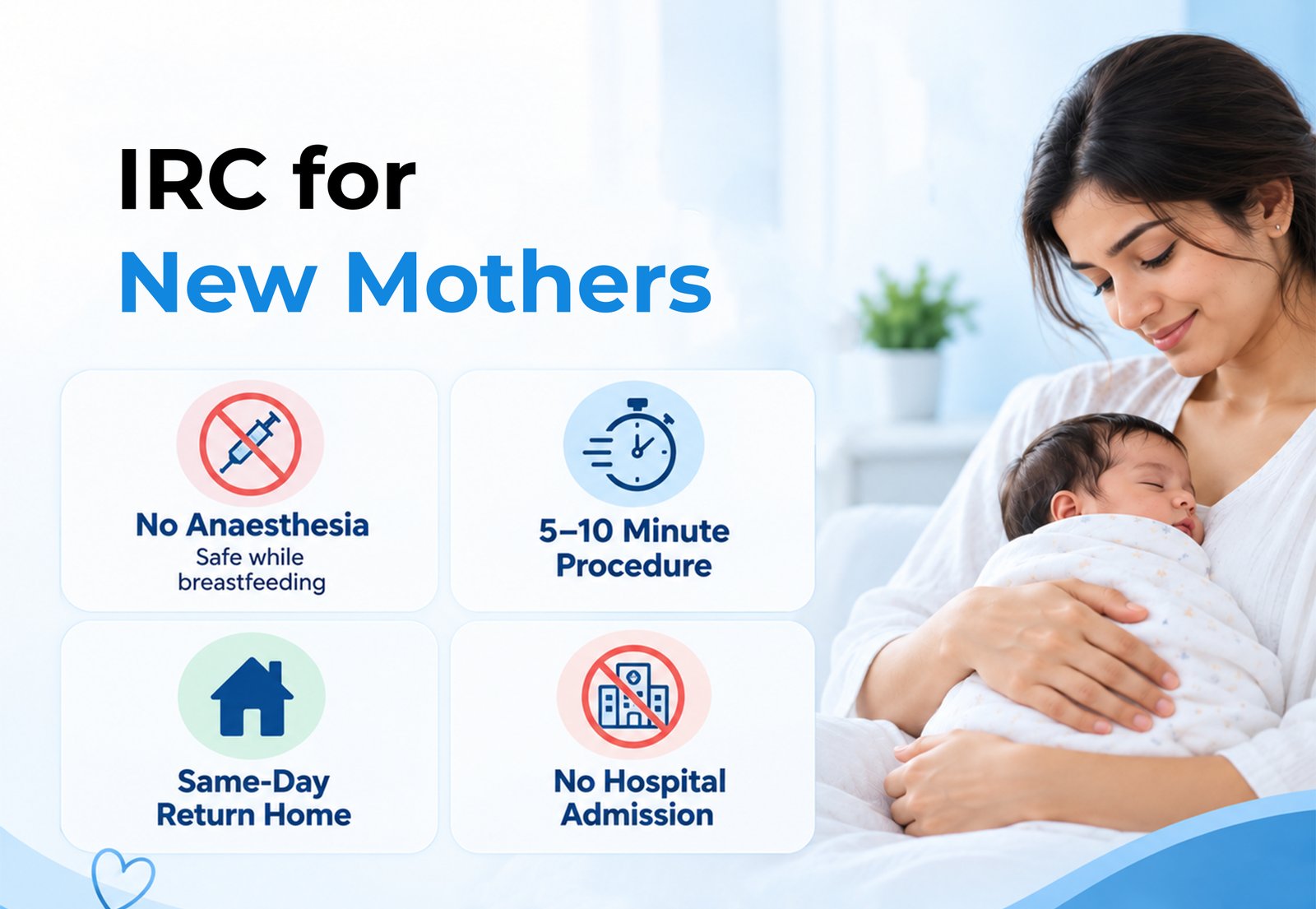
IRC is particularly well-suited for new mothers because:
- It requires no anaesthesia — completely safe while breastfeeding
- The procedure takes 5–10 minutes — you can come in and return to your baby the same morning
- No hospital admission — day procedure at Goyal Piles Care Centre, Sector 8, Rohini
- No recovery period — return to normal activity and breastfeeding the same day
A course of IRC typically involves multiple sessions spaced a few weeks apart, treating the haemorrhoidal columns progressively. Dr. Sushil Goyal will confirm the number of sessions required after examining your specific presentation.
For Grade III Haemorrhoids After Delivery — Laser Treatment
If delivery has worsened a pre-existing Grade II haemorrhoid to Grade III — with manual prolapse that requires pushing back inside — laser haemorrhoidoplasty (LHP) may be the appropriate treatment. This is typically planned after the 6–8 week postnatal check, once the body has had adequate time to recover from childbirth.
Laser treatment under spinal anaesthesia is generally considered safe once breastfeeding is established and the anaesthesia timing is managed correctly — Dr. Sushil Goyal discusses the specific timing with each breastfeeding patient individually.
The Breastfeeding and Medication Question
Every new mother treated at Goyal Piles Care Centre who is breastfeeding has her medication reviewed specifically for breastfeeding compatibility before any prescription is given.
What is generally safe during breastfeeding for piles:
- Dietary changes and hydration — completely safe
- Warm sitz baths — completely safe
- IRC procedure — safe, no medication involved
- Paracetamol for post-procedure pain — generally considered safe while breastfeeding
- Isabgol (psyllium husk) fibre supplement — generally safe
What needs individual review:
- Topical anaesthetic preparations — some formulations have limited data
- Anti-inflammatory topical preparations — review before use
- Stool softeners — some are safer than others for breastfeeding mothers
If you are breastfeeding, mention this explicitly when you call to book your appointment. It affects which options are offered and in what order.
How Long Do Postpartum Piles Last?
Piles that develop during pregnancy or after childbirth often improve after the baby is born with conservative management. However, the timeline varies significantly:
- Grade I haemorrhoids: With consistent dietary management, most improve within 4–8 weeks of delivery. They may resolve completely.
- Grade II haemorrhoids: May improve with conservative care but often require IRC for definitive resolution. Without treatment, they frequently persist and sometimes progress.
- Thrombosed external haemorrhoids: The acutely painful blood-clotted type that can develop suddenly after delivery. These typically reach peak pain at 48–72 hours and then gradually resolve over 1–2 weeks. If the pain is severe and presents within 48–72 hours of onset, surgical decompression under local anaesthetic may provide significant rapid relief — Dr. Sushil Goyal will advise based on your specific timeline.
- Grade III and above: These do not resolve with conservative care. Assessment and treatment planning at Goyal Piles Care Centre is required.
When to Come to Goyal Piles Care Centre After Delivery
You do not need to wait for your 6-week postnatal check to seek help for piles. If symptoms are significant, you can book an appointment at Goyal Piles Care Centre as soon as you feel well enough to travel to Sector 8, Rohini — typically from Week 2 post-delivery.
Dr. Sushil Goyal has been treating postpartum piles at our Rohini clinic for 37 years. New mothers from Rohini, Pitampura, Shalimar Bagh, and across Northwest Delhi are seen regularly — often referred by their obstetricians or gynaecologists in the area.
At your appointment:
- Tell us you have recently delivered — this changes the examination approach and treatment options
- Mention if you are breastfeeding — essential for medication review
- Bring a description of your symptoms: how long, what type of bleeding, whether a lump is present, and whether you have tried any treatment already
Frequently Asked Questions
Q: Is it normal to have piles after a C-section?
Yes — piles after C-section are common and often surprising. The hormonal changes of pregnancy affect all women equally regardless of delivery mode. Constipation from anaesthesia, pain medications, and reduced mobility after C-section often makes piles symptoms worse in the first week, not better. If you had haemorrhoids during pregnancy, they can persist or worsen after a C-section.
Q: How long after delivery can I have IRC treatment for piles?
IRC can be considered from approximately 6–8 weeks post-delivery — once the body has had time to recover from childbirth. The procedure itself is safe while breastfeeding as it requires no medication. Dr. Sushil Goyal will confirm the timing based on your recovery and clinical presentation.
Q: Are piles after delivery dangerous for the baby?
No. Postpartum haemorrhoids are a condition affecting the mother only. They do not affect the baby or breastfeeding directly. However, if piles cause significant bleeding and the mother becomes anaemic, this can indirectly affect energy levels and breastfeeding. Heavy or persistent bleeding should be assessed promptly.
Q: Can I use over-the-counter piles cream while breastfeeding?
Not without checking first. Several common OTC piles creams contain ingredients with limited or mixed breastfeeding safety data. At Goyal Piles Care Centre, we only recommend preparations confirmed safe for your specific situation. Call or WhatsApp +91-9999333166 to ask before using anything you already have at home.
Q: Will postpartum piles come back with my next pregnancy?
Piles that developed or worsened during pregnancy have a higher chance of recurring with subsequent pregnancies — the same hormonal and mechanical triggers apply. Treating them properly after this delivery and maintaining a permanently high-fibre, well-hydrated diet reduces but does not eliminate the risk in future pregnancies.
Book Your Post-Delivery Piles Assessment in Rohini
If your piles symptoms have not improved by 2–3 weeks after delivery — or if you have significant bleeding, a persistent lump, or severe pain — do not wait for your 6-week check. A 20-minute assessment at Goyal Piles Care Centre confirms your grade, tells you whether treatment is needed, and identifies the safest options for your specific postpartum situation.
476 verified Google reviews at 4.7 stars. Global Excellence Award 2019 — Best Laser Centre in North India.
📍 D-12/182, First Floor, Sector 8, Rohini, Delhi – 110085 Near Rohini East Metro Station Gate 2 | Opposite Metro Pillar No. 393
📞 Call or WhatsApp: +91-9999333166
🕘 Monday to Saturday | 9:30 AM to 1:30 PM
→ Piles treatment for women in Rohini → Piles treatment without surgery → IRC treatment guide — no anaesthesia → Diet guide for piles recovery → Difference between piles, fissure and fistula
This article is for informational purposes only and does not constitute medical advice. Please consult a qualified medical professional for diagnosis and personalised treatment.
