Why Does Fistula Come Back After Surgery? — Recurrence Explained by a Rohini Specialist

If your fistula has returned after treatment — after laser, after open surgery, or after Ksharsutra — you are dealing with one of the most frustrating situations in proctology. You went through a procedure. You recovered. And months later, the discharge is back. The pain is back. The sore near the anus is back.
Fistula recurrence is not rare. Anal fistula recurrence remains one of the most challenging problems in colorectal surgery. Rates vary depending on fistula type, complexity, and the technique used — but recurrence after primary treatment is a well-documented clinical reality. And critically — recurrence does not mean permanent failure. It means the original treatment did not fully address the fistula tract, or that a new tract has developed, or that the underlying cause was not eliminated.
At Goyal Piles Care Centre in Rohini, Dr. Sushil Goyal has treated recurrent fistulas — cases where previous treatment elsewhere has not produced permanent resolution — for 37 years. This article explains why fistulas recur, what the signs are, and what effective management looks like the second time around.
What Is Anal Fistula Recurrence — and How Common Is It?
A recurrent anal fistula is one where symptoms return after a period of apparent healing following treatment — whether that treatment was laser closure, open fistulotomy, seton placement, VAAFT, or Ksharsutra.
Even with modern minimally invasive techniques, some fistulas will not heal without further intervention — recurrence is a recognised outcome that requires reassessment rather than repetition of the same failed approach.
Recurrence rates vary significantly by:
- Fistula type — simple intersphincteric fistulas have lower recurrence than complex transsphincteric or suprasphincteric fistulas
- Treatment technique — some techniques have higher recurrence rates for specific fistula types
- Surgeon experience — complete mapping and treatment of the entire tract is technically demanding
- Post-operative care — incomplete healing from poor wound care or premature return to straining activity
The critical message: a recurrent fistula is not a treatment failure that means nothing more can be done. It is a clinical situation that requires reassessment — accurate mapping of the current tract, identification of what went wrong previously, and selection of the most appropriate next approach.
The 4 Main Reasons Fistula Comes Back
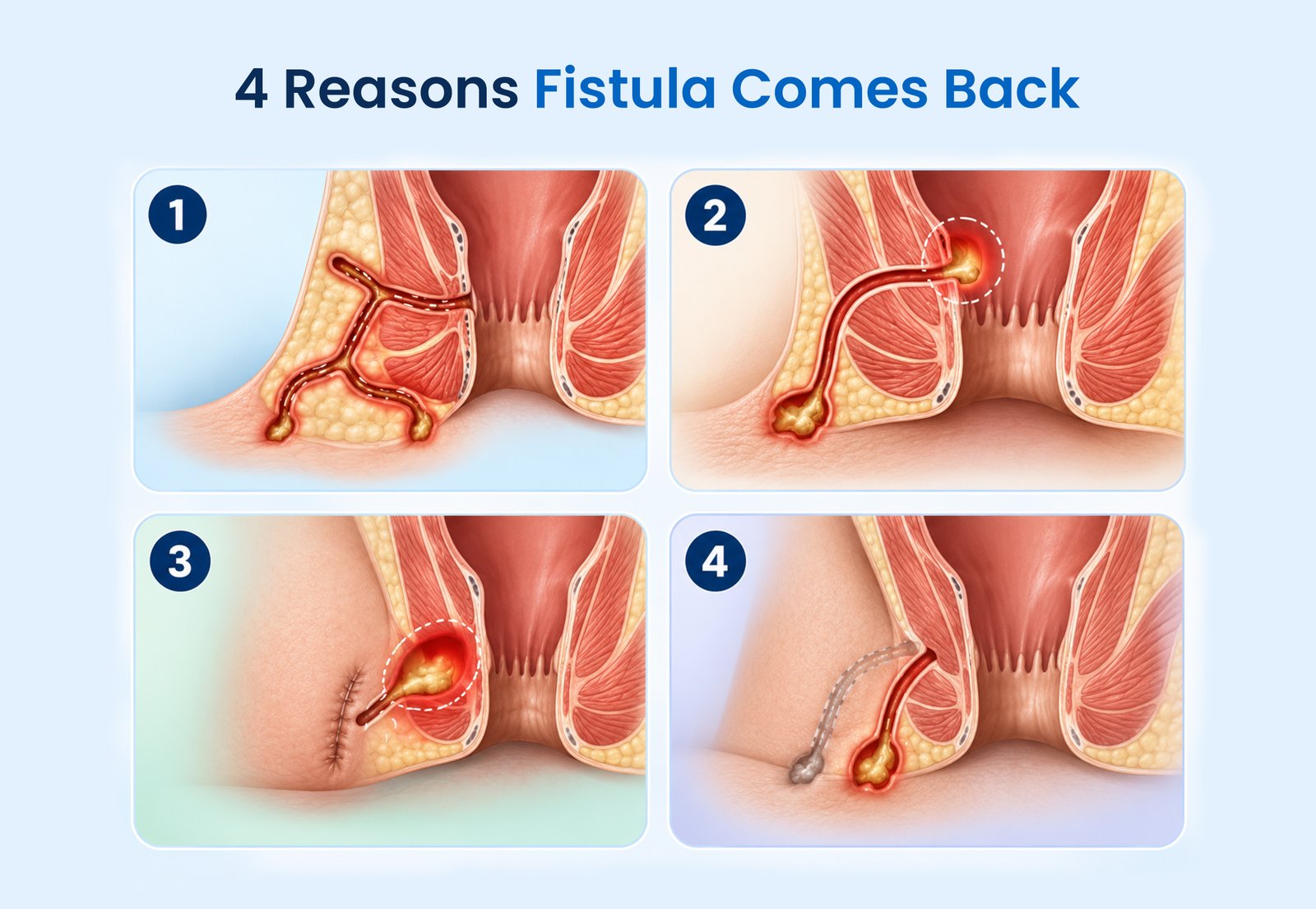
Reason 1 — The Fistula Tract Was Not Completely Treated
This is the most common reason for fistula recurrence. If any part of the fistula tract — including secondary branches, extensions, or the internal opening — is missed during treatment, the residual tract continues to harbour infection and discharge.
An anal fistula is not always a simple straight tunnel. Complex fistulas have:
- Multiple tracts — the primary tract plus secondary branches that extend in different directions
- Horseshoe extensions — the tract extends around the anal canal on one or both sides
- High internal openings — the internal opening is higher in the anal canal than anticipated, making complete access more difficult
- Multiple external openings — more than one opening on the perianal skin, each connecting to the same or different tracts
If the surgeon treats only the primary visible tract without fully mapping and addressing all extensions, the residual tract heals superficially — the external opening closes — but the internal portion continues to generate infection. Within months, the infection finds a new path to the surface, and the fistula appears to have returned.
What proper fistula mapping requires: pre-operative MRI of the pelvis to map the complete tract in complex fistulas, experienced intraoperative assessment of the tract with probing and injection, and confirmation that the internal opening has been definitively addressed.
Reason 2 — The Internal Opening Was Not Adequately Addressed
Every anal fistula has an internal opening — the point where the tract connects to the anal canal, almost always at the level of the anal glands. Failure to identify and definitively close or address the internal opening is one of the most reliable predictors of fistula recurrence.
In laser fistula closure (FiLaC), the laser destroys the tract lining from within. If the internal opening is not adequately sealed — either because it is positioned in a difficult location or because the energy delivery was insufficient — the infection source remains. The tract fills again from the inside.
In open fistulotomy, the tract is laid open and left to heal by secondary intention. If the internal opening is not fully included in the laid-open portion, it continues to drain internally.
Reason 3 — Premature Healing of the External Opening
Sometimes the external opening of the fistula heals over the surface before the tract has healed internally. This creates a closed pocket of infection — under pressure, with no drainage route. Within weeks or months, the infection accumulates, a new abscess forms, and either the original external opening or a new adjacent one breaks down.
This is particularly common after laser procedures where the external skin heals quickly — sometimes before the internal tract closure is complete.
What prevents this: regular post-operative follow-up to assess whether healing is progressing from inside-out (correct) rather than outside-in (premature sealing over an unhealed tract).
Reason 4 — New Fistula Development
In some cases, what appears to be recurrence is actually a new fistula — developing adjacent to the original site because:
- The underlying cause (an abscess or anal gland infection) was not fully resolved
- Crohn's disease is causing ongoing fistula formation in multiple locations
- Repeated constipation and straining are creating new anal gland infections
Distinguishing true recurrence (return of the original tract) from new fistula development requires examination and often MRI mapping. The management may differ.
Signs That Your Fistula Has Returned
After fistula treatment, the following signs indicate possible recurrence and require assessment at Goyal Piles Care Centre:
- Return of discharge — pus or blood-stained fluid from the healed external opening, or from a new opening nearby. This is the most common sign of recurrence and typically appears within 3–18 months of treatment.
- New swelling or tenderness — a new perianal swelling suggests abscess formation, which often precedes fistula recurrence or represents incomplete resolution of the original abscess.
- Sore that was healing has stopped progressing — the external wound from previous surgery that appeared to be healing has stopped closing, or has partially healed but continues to produce minimal discharge.
- Pain pattern returns — a dull, throbbing pain near the anus that was resolved after treatment has returned.
- Fever with perianal symptoms — new fever alongside anorectal swelling or pain suggests an active infection requiring urgent assessment.
Do not wait for symptoms to worsen. A new abscess that forms from an untreated recurrent fistula can extend significantly before it is assessed — making subsequent surgery more complex.
Assessing a Recurrent Fistula — What Is Different the Second Time
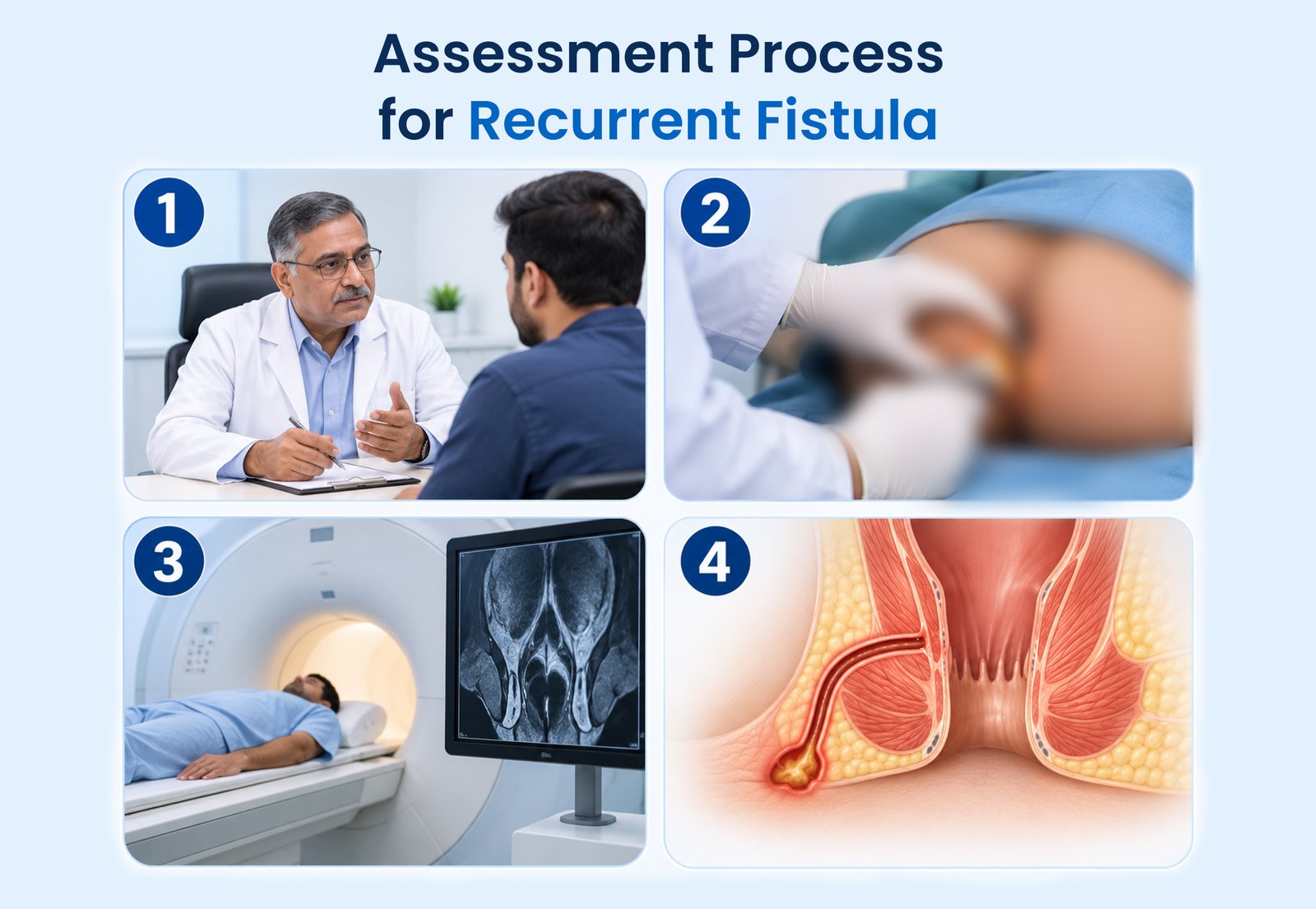
When a patient presents to Goyal Piles Care Centre with a recurrent fistula, the assessment is more comprehensive than for a first presentation:
- Complete clinical history of previous treatment. What was done, where, how long ago, what the post-operative course looked like, when symptoms returned.
- Examination under anaesthesia (EUA). In complex or recurrent cases, a careful examination under anaesthesia with probing and assessment of the tract is necessary to accurately map what is present now.
- MRI of the pelvis. For recurrent or complex fistulas, MRI is the most accurate way to map the complete current tract, identify all extensions and branches, confirm the location of the internal opening, and determine the relationship of the tract to the sphincter muscles.
- Assessment for underlying conditions. Recurrent or multiple fistulas raise the question of Crohn's disease, which causes ongoing fistula formation and requires a completely different management pathway.
Treatment Options for Recurrent Fistula
The treatment for a recurrent fistula is not automatic repetition of what was done previously. It is determined by:
- The current tract anatomy as mapped by examination and MRI
- What was done previously and why it appears to have failed
- The relationship of the tract to the sphincter muscles
- Patient factors including previous continence, comorbidities, and preferences
For recurrent simple fistulas (intersphincteric): Repeat laser closure (FiLaC) or fistulotomy is often appropriate if the previous recurrence was due to missed internal opening rather than a fundamentally unsuitable technique.
For recurrent transsphincteric fistulas: LIFT (Ligation of Intersphincteric Fistula Tract) or VAAFT (Video-Assisted Anal Fistula Treatment) may be preferable over repeat fistulotomy where sphincter preservation is a priority.
For complex recurrent fistulas: A staged approach — initial seton placement to allow drainage and reduction of inflammation, followed by definitive surgery after the acute phase — is often necessary before any definitive closure procedure.
For Crohn's-associated fistulas: Medical management of the underlying Crohn's disease is the primary approach. Surgical intervention is adjunctive. This requires coordination with a gastroenterologist.
The Most Important Thing About Recurrent Fistula — What to Do Now
Many patients with recurrent fistulas delay seeking assessment because they are demoralised by the failure of previous treatment, afraid of another procedure, or unsure whether further treatment will make any difference.
The clinical reality is this: Modern options like laser treatment, VAAFT, and LIFT are minimally invasive and far less painful than traditional surgery — and the procedures available in 2026 are significantly more sophisticated than the surgery patients' parents' generation feared. A recurrent fistula is treatable. The right approach, informed by accurate mapping of the current anatomy, produces permanent resolution in the majority of cases.
The starting point is an assessment at Goyal Piles Care Centre — a clinical examination, a review of your previous treatment history, and honest advice on what is most likely to produce permanent resolution in your specific situation.
Frequently Asked Questions
Q: My fistula came back 8 months after laser surgery. Is this normal? Recurrence within 8 months after laser fistula closure suggests either incomplete treatment of the original tract or premature external healing over an unresolved internal portion. It is not unusual — recurrence rates after FiLaC range significantly depending on fistula complexity and surgical experience. The appropriate response is assessment at Goyal Piles Care Centre, including examination and possibly MRI, to map the current situation and plan the most appropriate next treatment.
Q: Will the same procedure work again if my fistula has recurred? Not necessarily. The choice of procedure for a recurrent fistula depends on the current tract anatomy, why the previous procedure appears to have failed, and the relationship of the tract to the sphincter muscles. Repeating a failed technique without understanding why it failed is not appropriate — Dr. Sushil Goyal will assess the current situation specifically before recommending any next procedure.
Q: Does recurrent fistula mean I will always have this problem? No. Recurrence is a clinical complication — not a life sentence. The majority of recurrent fistulas can be permanently resolved with the correct assessment and appropriately matched treatment. Some complex fistulas — particularly Crohn's-associated ones — require long-term management rather than a single definitive cure, but this is a specific subgroup.
Q: How long after fistula treatment should I wait before concluding it has healed? Most fistula procedures show complete healing within 6–12 weeks. If the external opening has not fully healed by 12 weeks, or if discharge persists, reassessment is needed. Do not assume continued minor discharge is "normal healing" beyond 8 weeks — it may indicate incomplete closure.
Q: Can Ksharsutra treat a fistula that has recurred after laser surgery? Ksharsutra is an Ayurvedic medicated thread technique that gradually cuts through the fistula tract over multiple sessions. It has traditional use for simple fistulas. For fistulas that have recurred after laser treatment — which tend to be more complex presentations — Ksharsutra is generally not the preferred approach. Dr. Sushil Goyal will assess your specific anatomy and advise on the most appropriate option.
Assessment for Recurrent Fistula at Goyal Piles Care Centre, Rohini
If your fistula has returned after previous treatment — anywhere in Delhi or outside — a comprehensive assessment at Goyal Piles Care Centre is the right starting point.
Dr. Sushil Goyal, MBBS, FCGP — 37 years of treating anorectal conditions including recurrent and complex fistulas — will review your treatment history, examine your current situation, advise on whether MRI is needed, and give you an honest assessment of the most appropriate next step.
476 verified Google reviews at 4.7 stars. Global Excellence Award 2019 — Best Laser Centre in North India.
📍 D-12/182, First Floor, Sector 8, Rohini, Delhi – 110085 Near Rohini East Metro Station Gate 2 | Opposite Metro Pillar No. 393
📞 Call or WhatsApp: +91-9999333166 Monday to Saturday | 9:30 AM to 1:30 PM
---
This article is for informational purposes only and does not constitute medical advice. Please consult a qualified medical professional for diagnosis and personalised treatment.
