Anal Fissure Treatment in Rohini, Delhi — Laser, Medication or Surgery: Which One Do You Need?
There is a particular kind of pain that brings patients to our clinic with a sense of quiet desperation — the sharp, burning discomfort that comes after every bowel movement and lasts for an hour or two afterwards. The kind that makes you dread the toilet. The kind that leads to deliberate avoidance of passing stool, which only makes things worse.
If that sounds familiar, there is a good chance you are dealing with an anal fissure. And if you have already been using a cream for a few weeks without lasting relief, this article is specifically for you.
Fissure treatment in Rohini, Delhi has changed significantly in the last decade. Most patients today do not need open surgery. But the right treatment depends on whether your fissure is acute or chronic — a distinction that almost nobody explains clearly, and that makes all the difference in deciding what to do next.
What Is an Anal Fissure — and Why Is It So Painful?
An anal fissure is a small tear or cut in the lining of the anal canal — the short passage through which stool passes when you have a bowel movement. It is not a serious or dangerous condition, but it is an intensely uncomfortable one.
The reason it hurts so much is not just the tear itself. When the anal lining tears, the internal sphincter muscle — the ring of muscle that controls the anal opening — goes into spasm. This spasm reduces blood supply to the area (which is why fissures are slow to heal) and causes that characteristic burning, throbbing pain that can persist for one to three hours after passing stool. It is this sphincter spasm, more than the tear itself, that drives both the pain and the treatment strategy.
Acute Fissure vs Chronic Fissure — Why the Difference Matters
This is the single most important distinction in fissure treatment — and virtually no source explains it plainly.
Acute Fissure (Under 6 Weeks)
An acute fissure is a recent tear with fresh edges and a reasonable blood supply. The sphincter spasm is present but not yet entrenched. With consistent conservative treatment — diet changes, hydration, topical ointments, and sitz baths — approximately 50–70% of acute fissures heal within 4–8 weeks.
Chronic Fissure (Over 6 Weeks, or Recurring)
A chronic fissure is a different situation entirely. Over time, the repeated spasm and reduced blood supply cause the edges of the fissure to become fibrotic — hard, scarred tissue that cannot regenerate. A small skin tag often develops at the outer edge (called a sentinel pile), and a thickened papilla may develop internally. These structural changes mean the fissure cannot heal on its own, regardless of how much cream you apply or how much fibre you eat.
This is the point at which waiting and hoping stop being a viable strategy — and proper medical treatment becomes necessary.
Common Causes of Anal Fissure
Understanding what caused your fissure matters because treatment without addressing the cause leads to recurrence.
The most common triggers are:
- Constipation and hard stools — the most frequent cause. A bulky, hard stool stretches and tears the anal lining during passage.
- Chronic diarrhoea — repeated loose stools irritate and erode the anal lining over time.
- Low-fibre diet — produces dry, compacted stools that require straining.
- Prolonged sitting — reduces circulation to the pelvic region, slowing tissue repair.
- Childbirth trauma — particularly relevant for women who experience perineal tearing during delivery.
- Inflammatory bowel disease — Crohn's disease in particular is associated with atypical fissures.
Signs You Have a Fissure — Not Piles
Both conditions cause pain and bleeding, which leads to frequent confusion. The pattern is different.
Fissure symptoms:
- Sharp, knife-like or burning pain during and after passing stool
- Burning or throbbing that continues for one to three hours after a bowel movement
- Small amount of bright red blood on tissue paper — usually a smear, not dripping
- A visible small tear or skin tag at the anal opening
- Progressive avoidance of the toilet due to anticipated pain
Piles symptoms (internal):
- Usually painless bleeding — bright red blood in the toilet bowl or on paper
- A sensation of prolapse or a lump
- Itching or moisture around the anal area
| Feature | Fissure | Piles (Internal) |
|---|---|---|
| Pain | Sharp, lasting 1–3 hrs after stool | Usually absent for internal piles |
| Bleeding | Small smear on paper | Dripping or splashing blood |
| Location of discomfort | At the anal opening | Inside the rectum |
| Main concern | Pain and spasm | Bleeding and prolapse |
If you are unsure which condition you have, the right step is an examination — not self-diagnosis based on symptoms alone. Both are treatable, but they require different approaches.
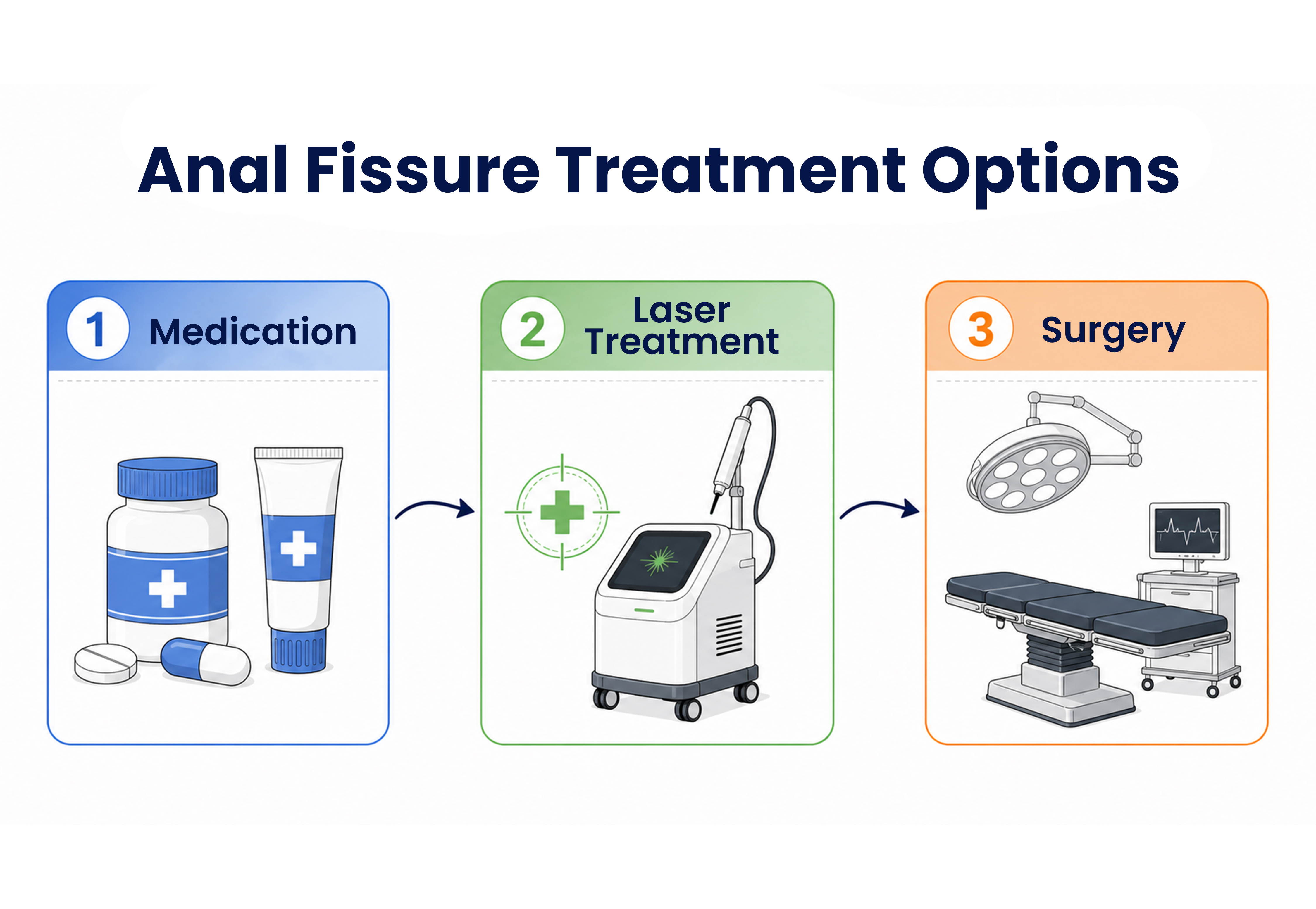
Fissure Treatment in Rohini, Delhi — Your 3 Options Explained
The appropriate treatment for your fissure depends on whether it is acute or chronic, how long you have had it, and whether you have already tried conservative management.
1. Conservative Management — Medication, Diet and Sitz Baths
Best for: Acute fissures (under 6 weeks), first presentation, no skin tag or fibrotic changes.
Conservative management is always the starting point for a new fissure. It involves:
- High-fibre diet — oats, lentils, fruits, leafy vegetables to produce soft, bulky stools that pass without straining
- Adequate fluid intake — a minimum of 2–3 litres of water daily
- Warm sitz baths — 10–15 minutes in warm water, 2–3 times daily, to relax the sphincter and improve blood supply to the area
- Topical lignocaine cream — applied before passing stool to reduce pain during the acute phase
- GTN or diltiazem ointment — prescribed by a doctor, these relax the sphincter muscle directly and are the most effective non-surgical option for relieving spasm
With consistent adherence, conservative treatment resolves approximately 50–70% of acute fissures. The key word is consistent — cream applied once a day or skipped on good days will not achieve the same results.
2. Laser Fissure Treatment — Day Care, No Open Wound
Best for: Chronic fissures, recurring fissures, patients who have already tried conservative management without lasting improvement.
Laser treatment for anal fissure at Goyal Piles Laser Centre in Rohini is a day-care procedure — you arrive, have the procedure, and go home the same day. No hospital admission is required in the vast majority of cases.
Here is what happens: a precisely calibrated laser is used to perform a controlled lateral sphincterotomy — relaxing the internal sphincter muscle — without making an open incision. The laser seals blood vessels as it works, which means minimal bleeding during the procedure and a significantly faster healing process compared to conventional surgery.
What to expect:
- Local or spinal anaesthesia — comfortable throughout
- Procedure duration: 30–45 minutes
- Discharge: same day
- Return to desk work: 2–3 days
- Return to physical work or exercise: 5–7 days
- Discomfort: mild for the first 2–3 days, managed with prescribed pain relief
Cost at Goyal Piles Laser Centre, Rohini: ₹15,000–₹35,000 (all-inclusive day-care — no hidden charges)
All laser procedures at our clinic use US FDA-approved equipment. The decision to use laser treatment is made after a proper examination and grading of your fissure — it is not offered as a blanket recommendation.
3. Lateral Internal Sphincterotomy (LIS) — Surgical Option
Best for: Severe chronic fissures that have not responded to laser treatment, or cases where anatomy requires open surgical access.
LIS involves making a small surgical incision to cut a portion of the internal anal sphincter muscle, permanently relieving the spasm that is preventing healing. It is performed under spinal or general anaesthesia and typically requires one night of admission.
LIS has an excellent success rate — it is one of the most definitive treatments for chronic fissure. However, it carries a small risk (approximately 3–5%) of minor incontinence, which is why it is reserved for cases where less invasive options are not appropriate.
Dr. Sushil Goyal recommends open surgical LIS only when laser treatment is not the right option for a specific patient's case — never as a default first approach.
When Should You Stop Using Cream and See a Doctor?
This is the question most patients delay answering — often for months. Stop self-treating with over-the-counter cream and book a consultation if any of the following apply:
- Your symptoms have persisted for more than 4–6 weeks despite consistent use of cream
- The pain is severe enough that you are avoiding passing stool
- You can feel or see a small lump or skin tag at the anal opening
- The bleeding is not reducing or is appearing more frequently
- Your fissure has healed and returned more than once after a course of cream
A recurring fissure that responds to cream temporarily and returns each time is a strong indicator of chronic disease — and chronic disease does not resolve with conservative treatment alone.
If you are unsure whether what you have is a fissure, piles, or something else entirely, an examination is the only accurate way to know. It takes under 5 minutes and is far less uncomfortable than most patients expect. You can read more about the difference between piles and fissure in our dedicated guide.
Why Rohini Patients Choose Goyal Piles Laser Centre for Fissure Treatment
Goyal Piles Laser Centre at D-12/182, First Floor, Sector 8, Rohini has been treating anal fissures — alongside piles, fistulas, and pilonidal sinus — since 1989. Dr. Sushil Goyal has personally treated thousands of fissure cases across all presentations, from straightforward acute fissures managed conservatively to complex chronic cases requiring laser intervention.
What patients consistently tell us after their first consultation is that they wish they had come sooner rather than spending months applying cream and hoping.
Every patient at our clinic receives a proper examination and an honest assessment of whether their fissure is acute or chronic, what the most appropriate treatment is, and what the full cost will be — before they agree to anything.
With 476 verified Google reviews at 4.7 stars, you can read patient experiences before deciding whether to book.
Our fissure treatment service page covers the full clinical details of how we approach each case. For patients dealing with both fissure and fistula, both conditions can be assessed and treated at the same clinic.
Frequently Asked Questions About Fissure Treatment in Rohini
Q: Can an anal fissure heal on its own without treatment? Acute fissures — those present for under 6 weeks — can heal with consistent conservative management in approximately 50–70% of cases. Chronic fissures, however, develop structural changes including a sentinel skin tag and fibrotic edges that make spontaneous healing essentially impossible. If your fissure has been present for more than 6 weeks or keeps coming back, it needs proper medical attention. Cream alone will not resolve a chronic fissure.
Q: Is laser fissure treatment painful? The procedure is performed under local anaesthesia — you will not feel pain during it. Patients typically experience mild discomfort and a warm sensation for 2–3 days after the procedure, managed with prescribed pain relief. Most patients find the recovery considerably more comfortable than they anticipated.
Q: How many sessions does laser fissure treatment take in Rohini? At Goyal Piles Laser Centre, laser fissure treatment is typically a single session. Unlike some IRC procedures for piles which may require multiple visits, fissure laser treatment is generally completed in one day-care sitting.
Q: What is the cost of fissure treatment in Rohini, Delhi? Conservative management costs are minimal — primarily prescribed ointments and follow-up consultations. Laser fissure treatment at Goyal Piles Laser Centre in Rohini costs approximately ₹15,000–₹35,000, all-inclusive. Open surgical LIS involves higher costs due to anaesthesia and admission. For an accurate estimate based on your specific case, call or WhatsApp +91-9999333166.
Q: Can a fissure come back after laser treatment? Recurrence is possible if the underlying causes — constipation, low-fibre diet, straining — are not corrected after treatment. Dr. Sushil Goyal provides dietary and lifestyle guidance to all patients after treatment, which significantly reduces the likelihood of recurrence.
The Right Time to Act Is Before It Becomes Chronic
An acute fissure caught early gives you real options — conservative management may be all you need. A chronic fissure left untreated for months means those options narrow, recovery takes longer, and the discomfort in the meantime is entirely unnecessary.
If you are in Rohini, Pitampura, Shalimar Bagh, or Prashant Vihar and have been dealing with fissure symptoms for more than a few weeks, a consultation is the most useful next step you can take.
📍 D-12/182, First Floor, Sector 8, Rohini, Delhi – 110085 Near Rohini East Metro Station Gate 2 | Opposite Metro Pillar No. 393
📞 Call or WhatsApp: +91-9999333166
→ Also Read: Fissure Treatment at Goyal Piles Laser Centre → Piles Treatment in Rohini → Fistula Treatment in Rohini
Related Links
https://goyalpilescarecentre.com/best-piles-doctor-rohini-delhi
https://goyalpilescarecentre.com/piles-treatment-rohini-delhi
https://goyalpilescarecentre.com/piles-clinic-rohini-delhi
This article is for informational purposes only and does not constitute medical advice. Please consult a qualified medical professional for diagnosis and personalised treatment.
